02 January 2018

e-mo-tion

Happy New Year!

Here's hoping 2018 is even better than 2017!
The submission deadline for the fabulous February 28, 2018 issue of Electric Spec is: Jan 15, 2018, midnight, US Mountain time.

We're starting to get enmeshed in the slush for the new issue, so I have a tip...
The number one job of an author is to evoke emotion in the reader. I can't stress this enough.
E-mo-tion is the most important component of every story. If I don't have an emotional reaction to a story, I'm much less likely to buy it. Conversely, if I do have an emotional reaction to a story, I'm much more likely to buy it! :)

What are some good examples of emotional stories? I happen to be rereading Connie Willis' excellent book The Best of Connie Willis: Award-Winning Stories (2014). In the past, I've discussed "The Last of the Winnebagos" (here and here) so I won't do that again. Instead, I'll mention "A Letter from the Clearys." Wow, talk about an amazing emotional reaction. It may be a perfect story. It starts very subltly: "There was a letter from the Clearys at the post office." What follows is a very slow reveal of something huge (I won't spoil it for you) done via an exceptionally well-created character. If you haven't read it, I highly recommend it.

Send us your emotion-evoking story!

19 December 2017

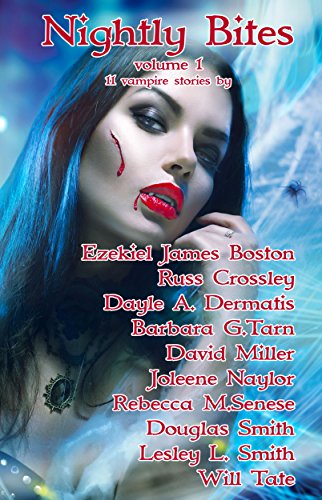
Nightly Bites

When you think of Christmas, you naturally turn to ...vampires, right? :) Okay, I admit that is a little nontraditional. But I'm very excited to be part of the fun vampire collaboration Nightly Bites, available now!
Next week back to our regular programming. :)

12 December 2017

no laundry lists

We're still enjoying the notable November 2017 issue of Electric Spec but have started working on the fabulous February 2018 issue. So, yes, we've started in on slush.
Additionally, I've been reading a lot of 'Best Of' short story collections and, consequently, have been thinking a lot about what makes an outstanding short story...

Description can be tricky for authors. It almost never works to have a laundry list of adjectives or other descriptors. If your fiction has any of these, get rid of them. Nix the tall, dark, and handsome.
I've noticed 'Best' fiction rarely has objective descriptions. Physical characteristics of people aren't even described. Speculative fiction, however, is a unique genre because stories often have non-human characters and non-Earth settings. In that case, you do need descriptions. But...

They should be subjective descriptions. They should be told only through the lens of your protagonist(s).
They should also serve the story. For example, the reader doesn't need to know King Zdofudasdlkf has five tentacles until the reader needs to know it. :)

Please send us your laundry-list-free stories!

05 December 2017

we're lovin' it

The notable November 2017 issue of Electric Spec is out and we're lovin' it! Which story is your favorite? There are so many to chose from...
  • "Sparks" by Heather Morris: When nine of the Dictator's ten cadres are hunting you, you've got to keep moving. So what kind of spark does it take to get you to stop?
  • "The Ballad of the Blind Hunt" by Matthew Hornsby: Two hunters are out for revenge in post-apocalyptic Texas. But you can't hunt the traditional way when your target is a pure-strain alpha freak.
  • "Clara" by Adriana K. Weinert: Some kids would be thrilled to have their toys come to life. Unless they're like Clara's toys.
  • "The Fish Kite" by Mary E. Lowd: Most people wonder what would happen if you could start over. In this tale, you'll find out what happens when that option is no longer available.
  • "The Chain Outside of Time" by Aaron Proctor: What if deja vu wasn't a fleeting moment but a full-time occurrence? Find out what life would be like in this thought-provoking story.

Thanks again, to everyone who helped make this happen!

And, thank you, Readers!

30 November 2017

We're live!

Huzzah! The notable new November 2017 issue of Electric Spec is live!

nov 2017 cover

Thank you everyone who contributed including our authors, our cover artist, and the editorial and technical staff.

You rock!

28 November 2017

from Author Weinert

We're excited about the notable November 30, 2017 issue of Electric Spec!

One of our excellent featured stories is Clara. We're pleased to feature some remarks by its author Adriana K. Weinert:


When I was a child, there was a period when I couldn’t sleep with the light out. Each evening, I would direct my mom to leave the desktop lamp on and pull a chair in front of it to shield me from its direct glare. Similar to Clara in my story of the same name, we all had monsters, imaginary or not, to struggle with as kids, and we all have scars, seen or invisible, to bear witness to battles won or lost.

Demons and monsters in the wardrobe are not only childhood afflictions though. As we grow, the wardrobe merely becomes less tangible and the monsters harder to call out. Insecurities, heartbreaks, and grudges reside in closets in our minds waiting to peek out. But I’ve found that once I resolve to crack the wardrobe door open and shine some light on what lies within, the monster deflates and is far easier to manage. The hardest part is to find courage to face what must be faced, as Clara too finds out.

Eventually, one night, I peeked under my bed finding nothing but dust and forgot to tell my mom to leave the light on. I’ve been sleeping in the dark ever since—through all the subsequent battles.


Thanks, Adriana! Very interesting!
Be sure to check out this story and all the others on November 30!

21 November 2017

from Author Lowd

We're excited about the notable November 30, 2017 issue of Electric Spec!

One of our excellent featured stories is The Fish Kite. We're pleased to feature some remarks by its author Mary E. Lowd:


When I was ten, my grandmother died from early onset Alzheimer's. At the time, we didn't know whether her Alzheimer's was of the genetic variety that would have passed down to my father, sister, and me. We've since learned that it was not. But that question cast a big shadow over a ten-year-old. I wondered what it would be like to lose my memories. I worried that was how I would eventually die. In my ten-year-old way, I found a certain kind of peace with it; a way to live under that shadow. I had to, because it wasn't lifted until nearly fifteen years later. By that time, I had a daughter of my own, and I was seriously pursuing a career (as much as that's possible) writing fiction. Perhaps unsurprisingly, a lot of my fiction dabbled with questions of memory -- what it meant, and what it meant to lose it.

The first story I ever sold, "Forget Me Not," was about a man with an addiction to memory drugs -- Leland was a character with an artificial quirk inspired by my father's own perfectly normal forgetfulness. My mother has always had an excellent memory; my father not so much, and his forgetfulness has often helped him to remember his past in ways that are more comfortable than how they actually happened. I pushed that natural dichotomy to the extreme and provided a science-fictional explanation for it. A few years later, I was shocked and delighted to learn that the mechanism I'd described for targeted memory loss had actually been backed up by real science. Sometimes when science-fiction writers stab in the dark, we can still get it right.

Anyway, one of the strongest images from that first story, "Forget Me Not," involved a fish kite that Leland had made as a child. His fish kite was inspired by my own collection of My Little Ponies. I loved those ponies and treasured them -- until I was in high school and wanted some money. Somehow though, as an adult, I could always remember treasuring them, but I had a hard time remembering I'd sold them. Hours of happy playtime figured much large in my mental landscape than a few minutes spent handing a box over for a fistful of cash. Those missing ponies haunted me like Leland's fish kite.

Fast forward another decade, and discover the wonders of eBay. As my daughter got older, when I wanted to play ponies with her, my husband ordered us old ponies -- just like the ones I'd sold so long ago -- from eBay. Now, I have a new collection of ponies, similar enough to the ones I sold that I don't go looking for them any more. I know where my ponies are -- right on the shelf where I left them. My daughter and I can play ponies together any time she wants.

I was thinking about how I'd healed my own memory wound by replacing the ponies, and I decided that it was time to revisit Leland's story -- maybe give my character a chance to heal of his own.

(For anyone interested in reading "Forget Me Not," it's available online here: http://deepskyanchor.com/forget-me-not/ It's part of an entire collection of my short stories focused on questions of memory, called The Opposite of Memory.)


Thanks, Mary! Very interesting!
Be sure to check out this story and all the others on November 30!

14 November 2017

from Author Proctor

We had a successful production meeting last week. Most folks in hold-for-voting) should have heard back from us by now (there may be a few stragglers...sorry!). We're excited about the notable November 30, 2017 issue of Electric Spec!

One of our excellent featured stories is The Chain Outside of Time. We're pleased to feature some remarks by its author Aaron Proctor:


Any good story should be woven from some big idea. Once storytellers lose that idea, the story seems to lose it’s reason for being told. We all know that great show that just went off the rails at some point. Well, I believe that happens when the writers lose their authentic sense of of the idea upon which the story grows.

While writing “The Chain Outside of Time," I drew upon my past struggles with addiction. The fatalism. The isolation. But that doesn’t mean that the story is specifically “about” addiction because I’ve seen that fatalism and isolation reflected in the faces of many of you out there. Maybe you’re depressed. Maybe you’re anxious. Maybe you just feel out-of-step. And maybe this is all just grandiose writer BS; but—for better or worse--it helped me write the darn thing.

And I really hope you enjoy it and get something out of it.


Thanks, Aaron! Very interesting!
Be sure to check out this story and all the others on November 30!

07 November 2017

Short Fiction as a Marketing Technique

If you are reading this, you are probably a writer. We writers are living in a wonderful new age of possibilities. From Indie- and self-publishing, to bundles and anthologies, ezines, crowd-sourcing, Patreon, and everything else, there have never been more opportunities for writers. Isn't it awesome?
Unfortunately, it also means there's never been more competition for readers.
Writers need marketing for their work. A difference between publicity and marketing is: publicity is putting your product in front of other peoples' audiences, while marketing is putting your product in front of your audience.

Thus, an excellent way to market your fiction is via short stories. Short fiction can help create your audience. It gives readers a specific taste of what you have to offer. (What other artistic endeavour can do this?) Short stories are thus even better than ads, and bonus: editors pay you rather than the other way around. Short fiction enables you to get your name out there. Depending on the short story venue, you can get your name and product out in front of people you might not reach otherwise--but they're still readers who are interested in your kind of stuff.

In the case of Electric Spec we post an author bio and often an author blog post, as well as keeping your story itself posted forever (or until you ask for it back). Can you say: link s to your website and social media? And, yes, links are good things.

And oh yeah, there are other benefits to short fiction. It can really hone your writing skills. If you can writ e an excellent short story, let's face it, you can do almost anything. :)
Bottom line: short fiction is an excellent marketing tool!

What's happening with Electric Spec? Why, I'm glad you asked. :)
We finished the slush pile for the notable November 30 2017 issue. All authors should have heard from us with either a 'no thanks' or a 'we're going to hold this for voting.' If you didn't hear from us by now, something probably went awry. Please resubmit your story.
Next week I'll blog about the production meeting and start bragging about the new issue! Stay tuned!

31 October 2017

Avoid the Smeerps

We are working hard on the notable November 2017 issue of Electric Spec! Here are some more comments inspired by the slush pile...

When science fiction first began a few authors tried translating a standard story, for example a western, to a science fiction milieu. In such a case, they would give different elements of the story science-fictiony names, but that's all they would change. Editors and critics refer to this kind of lazy writing as 'calling a rabbit a smeerp.' Once in a while, we get a story like this. Don't do it!

Ideally, every science fiction story has some uniquely SF element that is crucial to the story. It actually doesn't matter what you call things.
The real trick is to show protagonists deal with this uniqueness in a compelling way that resonates with readers, in a way that evokes emotions in readers.

Speculative fiction has the added challenge that protagonists aren't necessarily human. In fact, the protagonist often isn't human. Think ghost, werewolf, elf, god, alien, robot... You get the idea. I've disagreed with other writers in the past, however, in that I say none of these protagonists are truly not-human. Since readers are human, they need something they can relate to. Do you agree? Disagree?

Send us a story that proves me wrong!

And, oh, yeah, Happy Halloween!

24 October 2017

In Media Res

We, the Electric Spec Editors, are working on the notable November issue, and are deep in the slush pile. Thank you for sending us your stories! Feel free to send us new stories now for our first issue of 2018.
Regarding the slush...

I've been noticing lately that our society is more fast-paced than ever. We're used to instantaneous news, texts and pictures. Our reading habits have changed as well. In particular, for on-line publications we want to grab a reader's attention more quickly than ever.

It has always been a good idea to begin your story in media res--in the middle. Now, it's more important than ever! Let's face it, you don't want to bore your potential readers (including editors) with a lot of pointless chit-chat in the beginning of your story. (In fact, drop all the pointless chit-chat). You don't want to begin with the protagonist waking up in the morning. You don't want to begin with the protagonist traveling somewhere.
Some markets like a story that begins with a lot setting descriptions; that is not this market.

You do want to begin your story when the story begins, not when the setup begins. If need be, you can give the reader backstory or a flashback after you've already gotten them hooked.
When does the story begin? When the protagonist is in trouble, has a signficant problem--which is about to get much worse.

A slow opening is one of the most common reasons for a story to be rejected. Take a look at the beginning of your tale: do you start in media res? If not, consider cutting or moving some of the setup.

Good luck!

17 October 2017

use specific details

Sadly, submissions for our last issue of 2017 are closed. Happily, we are accepting subs for the first issue of 2018.

We, the Electric Spec editors, are hard at work on the new issue. Right now that means we are going through the slush pile. Thank you for sending us your stories. We wish we could critique all the stories we get, but we just don't have that kind of person-power. So, here'a tip you might find useful.

Unique specific details make a story stand out. It's specific details that create your fictional world. The good news is: you, as a person, know a lot of unique specific details. Get them out, dust them off, put them in your story. Blow us away! For example, a black Aston Martin DB5 is much different from a silver Prius C, right?
The trick to making this work is expressing the details via your characters. When your characters convey unique specific details it actually helps you create unique characters. For example, does your character love his Prius, or hate it?

Send us your stories with unique specific details!
And check back here for more tips from the slush pile next week...

10 October 2017

showing and telling

Less than a week until the submission deadline for the final 2017 issue of Electric Spec: October 15, 2017! Get those stories in!

In the meantime, we've starting working behind the scenes to get the new issue out. I've also been reading a book on the history of storytelling, all of which has made me think about the whole showing versus telling thing.

Experts disagree on when the first novel was published. Some say it was Le Morte d'Arthur by Thomas Malory in 1485, but there are many other opinions. Let's just say, prior to about 1400, storytelling was primarily an oral tradition. Imagine those folks of long ago sitting around the fire telling stories. Some of us have had that experience while on camping trips telling ghost stories and the like. Notice my verb choice: telling. These stories were often narrative summaries of exciting events such as hunting expeditions, death-defying stunts, or scary hook-handed monsters in lovers' lanes. Telling stories orally is still quite common around the world, right? Let me tell you what happened today at work....

When the modern novel was borne showing became popular in storytelling. Some experts claim literary novels are mostly showing the details of one or more particular persons, places or things. In fact, a current writing mantra is Show, don't tell. Some would say we've abandoned the excitement of telling.

I say: showing is exciting when you're showing exciting events in the moment. This enables readers to be right smack in the middle of the action. At Electric Spec we very rarely buy stories that do not have this type of showing. However, the best stories have both showing and telling. Show the exciting bits. Tell, or summarize, the less exciting parts.

What do you think of the whole showing versus telling dichotomy?

03 October 2017

editor advice

The submission deadline for the notable November 2017 Electric Spec issue is October 15, 2017! Get those stories in!

Of course, this means we are starting to gear up for this new issue. This editor is deep in her slush pile--which means I have some advice for prospective authors. I think this advice is pretty general:

  • Do check the submission rules of your desired market and follow them in your document. This includes: file format, document formatting, word length, genre, and, basically anything else that's listed.
  • Do write a reasonable cover letter. This includes name, contact info, word-count, genre, and a short bio, including a few previous pubs. If in doubt, shorter is probably better.
  • Do familiarize yourself with the market to make sure your story is compatible. The good news is: it's free on our site. :)
  • Do avoid spelling and grammar errors--especially on the first page.
  • Do grab my attention on the first page. There are a myriad ways to do this. It could be a great character, a great plot, setting, mystery, anything. You want me to think Ooh! I need to read more!
  • Do have something changed at the end of the story.
  • Do create something unique.
For me, personally, I really enjoy a very strong character voice. It's great when a character comes alive and practically leaps off the page.
We want more steampunk. I also really enjoy genre mashups. Okay, if I'm being honest, it's hard to me to resist time-travel tales and SF involving quantum physics. Send them to us!

26 September 2017

to the Edge and Beyond

I recently attended a literary conference with authors from around the world. A very interesting session was entitled "To The Edge and Beyond." It was supposed to be about speculative fiction, mystery, and horror. But the participants went to the edge of a typical writers' discussion and then, beyond, when they got into some philosophical issues.

One thread addressed the question: are authors really always writing about themselves? I had believed in some sense, every character is the author. But the idea that every piece of writing is about the writer was a new one for me. I'm not sure I agree. What do you think?
Closely related to this idea is: can writers inhabit otherness? Can they truly inhabit an alien being, be it a literal animal (or whatever) or a metaphorical one? I don't think they can. What do you think?

One thread dealt with the writer-reader relationship. Both writing and reading are transformative processes. Both are intimate processes, almost involving mind-to-mind communication. Wow. That's kind of mind-blowing to think about (as I write this and you read this)!
As with other forms of art, this two-person communication is necessary to make it art. Or is it?

When considering writers as artists... Some people think artists must walk a tightrope between the alien and the familiar. Art is the union of the bizarre and the normal. In creating art, do artists create a new world of the imagination?

Why do people read? One author said mystery is at the center of everything and readers are trying to solve mysteries. Or do readers want to be transformed? What about transgression? One author thought readers want to do things in literature that they can't do in real life. What do you think?

Suffice it to say, I'm still pondering all this stuff!

The submission deadline for the final issue of 2017 is October 15. Get those stories in!

19 September 2017

Story Beginnings

The beginning of your story is the most crucial part. Your story beginning can capture a reader, get him/her to read your story or ...not. The most crucial reader is the editor who gets your submission. If you don't get him/her to read, you won't get others to read. Beginnings are crucial for editors because, sad to say, often editors only read the beginning of a story.

Probably the most common issue we see with stories is authors start the story too soon. Authors want to start at the beginning, but they need to start when the action starts--literally or metaphorically.
Rarely do you want to start with the protagonist being born, waking up, eating breakfast, driving somewhere, arriving at the office, answering the telephone, etc.

As an author myself, I totally understand the urge to start at the beginning. What I do is write those scenes (because I can't seem to help it) but then cut them after I've finished the first draft. I highly recommend looking at your first draft the way you imagine an editor would. What words does your story beginning need? Cut the extras.

A very effective writerly trick can be: giving a little non-chronological telling in the first paragraph of a story. This telling can really hook the reader. For example, The day I died was not a good day. I want to know what happened. Don't you? Consider a little telling.

Good luck with your story beginnings.

12 September 2017

Thank you

Here at Electric Spec we are still reveling in the awesome August 31, 2017 issue! It was a real pleasure to publish this issue and work with the authors. In case you haven't checked it out yet (impossible!) our featured stories were: "Karda Burns" by Roderick Phillips, "Ada, or, The Limits of Logic" by Robert Dawson, "All Our Goodbyes, All Our Hellos" by David Cleden, "A Familiar and Her Wizard" by Jeff Stehman, and "Paper Walls" by Matt Hollingsworth. I highly recommend all of them.
Thank you very much, Authors!
Thank you very much, cover artist Brian Malachy Quinn!

I'd like to thank our associate editors Chris Devlin, Minta Monroe, and Candi Cooper-Towler. Thank you!
I'd also like to thank the other editors Nikki Baird and Grayson Towler. Thank you!
Thank you to our tech support folks, too!

Thank you to all the aspiring authors who submitted to us for the issue. We appreciate you!
And especially, thank you, to our readers! We wouldn't exist without you! You rock!

And now we turn to the final issue of 2017...

05 September 2017

from Author Hollingsworth

Hopefully, you're still enjoying the awesome August 2017 issue of Electric Spec. To make it all the sweeter, here are some comments from author Matt Hollingsworth, relating to his story Paper Walls.

How to Write a Convincing Story About an
Unfamiliar Subject

Back in high school, I tried writing about 20’s gangsters. I did no research beyond what I’d seen in movies. I just wrote the story and turned it in to a writing workshop, ready to be showered with praises for my genius.

As you might have guessed, that wasn’t what happened.

After the group was done picking apart my inaccuracies, I sulked back home with my ego significantly deflated.

Maybe you’ve had a similar experience. Maybe there’s a topic you’re passionate about but are warry of after being told to “write what you know,” too many times.

So how do you write convincingly about an unfamiliar subject? Well, the short answer is to become familiar with it through research.

When I first started writing, research was a dirty word to me, probably because of school. I was scarred by long research assignments, reading old books on subjects I didn’t care about.

Fortunately, I soon discovered that research wasn’t nearly as bad as I thought. In fact, I’ve started to enjoy it. Unlike school assignments, when I research a short story, I’m learning a subject I actually care about.

With research you can:

  • Add realism to your story through key details
  • Avoid glaring inaccuracies that can distract a reader (or publisher) from your story
  • Add a layer of subtlety that will draw your reader in

Here are some research strategies I use for my fiction.

Ask an expert
Obviously, this is the best tactic. Speaking to someone who knows your subject well can reveal intricacies that books or the Internet never could.

My short story Paper Walls is about a young woman with schizophrenia in a mental hospital, something outside my realm of experience.

While I didn’t know anyone with schizophrenia in particular, I did know someone with a mental illness who had spent time in a mental hospital. And when I explained my concept for the story, he got excited and wanted to talk to me about his experience. I learned a lot from him that I might not have otherwise.

Whatever your subject is, there’s a good chance you know someone who is an expert (or at least knows more about it than you do).

Don’t just read the technical material
While talking to someone is preferable, it’s not always an option. And for that we have the treasure-trove of knowledge that is the Internet.

Unfortunately, one common mistake people make is to simply read technical articles on their subject and ignore the emotional elements.

While the psychological/medical articles about schizophrenia were useful, they didn’t really tell me what it feels like to have schizophrenia. Fortunately, I found a treasure trove of essays and videos by people with the illness talking about their experiences.

Listening to other people’s emotions makes it easier for you to put yourself in their shoes and imagine how you would feel in their situation.

Relate to events in your real life
While I’ve not been to a mental hospital, I have been to therapy and I have had trouble opening up to people, so I decided to make these sources of conflict in Paper Walls.

Think about something you’ve experienced that might give you a window into your subject.

Maybe your story is about an son and his estranged father. You might be very close to your father, but surely at some point you’ve been mad at him. Take that emotion and extrapolate outwards. Put yourself into your research and consider how you might feel.

Write an unfamiliar subject by becoming familiar
With the internet, instant communication, and libraries on every corner, we have access to more information than any other authors in history.

Using research, you can write convincingly about even the most unfamiliar subject.
Read more at https://jmhollingsworthblog.wordpress.com/.


Thanks, Matt!

31 August 2017

Huzzah!

The Awesome August 2017 issue Electric Spec is live! Thank you, all!

aug 2017 cover
Cover image by Brian Malachy Quinn