27 September 2011

story premise

An author should be able to state the premise of every story he/she submits. By premise I mean the hypothesis or argument or assertion or insert-your-term here of the story. You should be able to summarize your story's essence in one sentence. For example, right now I'm working on a story which has the premise: a man has to travel to another planet to learn the true nature of love.

If you can't do this for your story then your story is not finished.

Now, I'll be honest with you. In my example that wasn't the exact idea I started with. My process (and everyone has a unique process) is I *think* I know the beginning, middle, and end of my story before I start writing and so I write the first draft. I read what the result says. Usually it says something somewhat different from what I thought it was going to say. I have to decide on the story premise. I revise, including cutting all the stuff that doesn't support the premise. Sometimes I have to add a bit. The point is to create a coherent story.
Your method will differ from this. But... you must ask yourself:

What is your story premise?

23 September 2011

faster than light?

I can't resist a another little science tidbit. The scientific world has been in an uproar lately because it appears a European experiment called OPERA has measured a neutrino travelling faster than the speed of light (186,282 miles per second)! The OPERA experiment observes a neutrino beam shot through the earth from CERN to Italy’s INFN Gran Sasso Laboratory 730 km away. See, for example, CERN's press release.

If true, this would be huge. HUGE. HUGE. Why, you ask? It was none other than Albert Einstein who hypothesized the speed of light is the fastest any particle can go. Since then (1905) numerous experiments have seemed to support Einstein. If Einstein's wrong some of the more speculative consequences include traveling to the stars, time travel, and the end of causality. See what I mean? HUGE.

I suspect, however, OPERA will be proved wrong.

20 September 2011

funny writing

Now that the excitement of the August 31 ElectricSpec Issue is abating, we editors are valiantly going through the slush pile. I came across a piece that was trying to be funny, I think. Sadly, it didn't quite work. Humor is tricky. I've blogged about it before, but the point is: humor is based on surprise. It's tricky because suprise is based on one's background and expectations--and these are different for everyone.

I did hear a joke at conference which will illustrate my point:

What's brown and sticky?

A stick.


This works because we don't think of a stick as gooey, but of course, it is stick-like. Our brain has to readjust because we end up somewhere we weren't expecting. :) The surprise is key. For example, What's white and frosty? Frost. isn't as funny because it's not as surprising.

Humor is very subjective. For example, our Editor's Corner story "The Dog that Broke the Camel's Back" was humorous to some, and annoying to some. Although, hopefully more the former than the latter.

So, I guess my point is, we enjoy humor here at ElectricSpec. Give it a try, but be careful. Good luck!

14 September 2011

potentially habitable planet?

Okay. I can't resist passing this article along from io9.com: Potentially habitable "Super-Earth" is among 50 newly discovered exoplanets. "HD 85512 b is a rocky planet about 3.6 times the mass of Earth, located right at the edge of its star's habitable zone. That means it's capable of supporting life... and the early results suggest it's a very real possibility."

Read more about the La Silla Observatory here.

13 September 2011

conference exhaustion

We trust you have been reading and enjoying the new issue of Electric Spec (now that we resolved the technical issues)!

We, the editors, all attended the fabulous annual Rocky Mountain Fiction Writers conference in Denver this past weekend. As editors, we hosted some events including the intensive short story workshop on Friday afternoon and "Literature and Liquor" in the bar Friday night. For your information, the story we picked to read and discuss was: Streetwise by Phil Emery. Check it out! :)

If you participated in either of these events: Thank you! If you came up to us and said "Hi!" or that you liked the ezine: Thank you!

As writers, we participated in some other events (I talked about my events here). Personally, I'm still exhausted! Phew. I guess my point is even though writers' conferences can be exhausting, they are very valuable. They are great opportunities to learn about writing, marketing, or whatever else you need to learn at this time (I know this evolves). They are great opportunities to network and connect with other writers and even editors and agents. They fire up your writing engine!

So, if you're a writer, I hope you take the time to go to writers' conferences. Possibly, consider going to the RMFW conference next September. And if you're a fan of speculative fiction, don't even get me started on the awesomeness of conferences like WorldCon or Comic-Con or World Fantasy.
Hope to see you at a con!

07 September 2011

we're okay

I think we're okay. The site is back up.
Thanks for your patience! :)

06 September 2011

bear with us

Greetings, readers! I hope you're having an easier time of things lately than we are. As you probably noticed, we're still having technical difficulties. Bummer! Obviously, the timing is very bad as we just published the fabulous new issue. Please bear with us as we get this sorted out. We will sort it as fast as humanly possible.

Interesting Electric Spec trivia: our website is hosted in the U.K. Why? This is kind of a long (and top-secret?) story. The short version is: a Famous Author who used to be a software guru set up our system when he still had a day job. That's all I can say. Sorry. If I tell you more, I'd have to kill you--and I don't want to do that!

In other news, our email still works. Please keep submitting stories for our next fabulous issue!

01 September 2011

New Issue Out!

As promised, the new issue of Electric Spec is out!
Thank you very much to everyone who contributed! We appreciate you!

30 August 2011

New Issue Tomorrow!

The editors are thrilled to present a brand new issue of ElectricSpec tomorrow August 31, 2011! For your reading pleasure we have 6 excellent short speculative fiction stories:
  • T. Lucas Earle's "Monkey Talk"
  • "Justice Like a Mighty River" by Alter S. Reiss
  • "Tooth and Claw" by Erin and Rina Gonzales
  • Rich Matrunick's "Stranded (with Pork Chop)"
  • "The Coincidence Factory" by Fredrick Obermeyer
  • and in Editor's Corner: David E. Hughes' "Give . . . Grieve"

We also have an exciting interview of Urban Fantasy Author Nicole Peeler and dramatic cover art by Karl Eschenbach.

Check it out tomorrow!

23 August 2011

New Issue Coming

We are just about a week away from the exciting new issue! W00t! Things are pretty hectic here behind the scenes at ElectricSpec. The editors are finishing up editting the stories and starting to post them--after getting approval from the authors, of course! We're drafting our fabulous Message From the Editors, and if you don't think some fist fights or arm wrestling breaks out over that...you'd be right. :) We even had a fun failure of the content management system we had to deal with. Don't ask me what the heck was going on there.

So, what do you have to look forward to in our fabulous August 31, 2011 isse? You get some great cover art, you get five--count 'em five--shockingly good speculative fiction stories. As a bonus you get a flash piece in Editor's Corner. We also have an awesome new interview with up-and-coming Urban Fantasy author Nicole Peeler, in which she talks about the latest and future books in her Jane True series, sexual teasing, how a Ph.D. in English Literature helps one write Urban Fantasy, her "super bolshy" personality and much more.

Check it out August 31, 2011!

16 August 2011

story first sentences

As you gentle readers may or may not have guessed, all of us Electric Spec editors are also speculative fiction writers. One of the things I've been studying lately is what distinguishes a great story from a good story? Of course, sometimes it takes the lens of history to tell what's great. I hypothesize, however, that one significant factor is a good first sentence. Let's look at some historical examples:
  • In "Nine Lives" Ursula K. Le Guin begins with She was alive inside, but dead outside, her face a black and dun net of wrinkles, tumors, cracks.
  • In "Light of Other Days" Bob Shaw begins with Leaving the village behind, we followed the heady sweeps of the road up into a land of slow glass.
  • Arthur C. Clarke begins "The Star" with It is three thousand light-years to the Vatican.
  • Henry Kuttner and C.L. Moore begin "Mimsy Were the Borogroves" with There's no use trying to describe either Unthahorsten or his surroundings, because for one thing, a good many million years had passed since 1942 Anno Domini, and, for an other, Unthahorsten wasn't on Earth, technically speaking.
  • In "The Life and Times of Multivac" Isaac Asimov begins with The whole world was interested.
  • In "The Singing Diamond" Robert L. Forward begins with My asteroid was singing.
  • In "The Xi Effect" Philip Latham begins with For a week the team of Stoddard and Arnold had met with nothing but trouble in their solar infra-red exploration program.

If I had to summarize my reaction to these sentences, they would probably be "What the heck is going on here?" (rated-G version)
But the point is, I'm hooked. This is something to aspire to.

However, through the lens of history, many of these stories had awesome ideas and maybe less effective emotional impacts. For example, "Nine Lives" explores the idea: what if you were a clone, used to being surrounded by versions of yourself and that ended? Who or what would you be then? Could you even survive? Le Guin doesn't put us inside the head of the most affected character, however.

I think today's readers want both a big idea and a big emotional impact. What do you think? You'll have to read our upcoming August 31 issue of ElectricSpec and see if you think we pull it off. :)

09 August 2011

story logic

We had an unusual event at our production meeting last week, namely we didn't end up publishing a story that we all liked a lot. The world was neat, the protagonist was active and empathetic, there was a cool plot twist and the ending was satisfying. So why didn't we publish it? One of us asked the question: "But what was the protagonist's original plan? Why did he do what he did?" And none of us could answer the question. As far as we could tell, the protagonist's original plan would never work. Upon close inspection, the story didn't work; it fell apart. :( Bummer.

So, what's a poor author to do to avoid such situations? I think you have to try to back up and get some distance from your stories when they're done. Of course, critique groups and/or beta readers can help here. Ask the tough questions, including, "Does this make sense?" If not, figure out how to make it make sense! Make sure your story has some kind of logic. Good luck!

04 August 2011

Production Meeting Week

Wow, hi. Been awhile for me over here at this blog. I'm just emerging from what is fondly becoming known around my house as the "Busy Summer From Hell" replete with book releases and deadlines. But I haven't forgotten you, or Electric Spec!

I just read some slush recently and I noted a few things.

Quite a few present tense stories. One I even saved for voting. Wanna know why? I didn't realize it was present tense until about a third of the way in, cuz I was so into the story. Compelling character, writing, and plot. It had it all. I recently just had a review of my own present tense story that said the very same thing!

Another thing I've noticed lately about stories I've chosen to get a second reading; they leave a lot of room for me, the reader. Details are provided, but not every detail. Just enough for me to sketch a picture in my mind. I get to be the one to pick the paint colors. No paint-by-number stories pass by this editor for voting.

They also tend to rest at the intersection of Trope Avenue and Twist Road. Meaning, taking trope like known character types and putting them in a new situation or place. Or regular old Anytown, USA town council run by, I dunno, a  Garuda who just immigrated from India. In other words, give me something I don't expect. But don't stray so far I can't figure it out without your spending 1000 words to explain it to me, either.

All the stories were, well, stories. There were characters doing stuff. Cool stuff, mostly, against big odds. With stakes and stuff.

Anyway, we're deciding this week and it's gonna be a tough one. Might require an extra beer or six to work it all out. :)

02 August 2011

Writing on Reading: Robinson's Science in the Capital

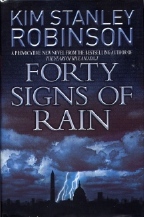
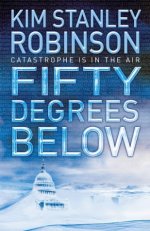
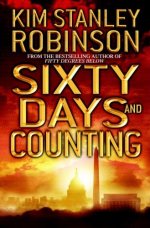
I just finished the final book in Kim Stanley Robinson's so-called Science in the Capital series: Forty Signs of Rain (2004), Fifty Degrees Below (2005), and Sixty Days and Counting (2007). Most of this work occurs in Washington D.C. at the N.S.F headquarters and features scientists. With its long lyrical descriptions of things ranging from nature to buddism to climate change, this series is quintessential Robinson. These books also have a strong message.

Yes, climate change is here and it has dire and long-ranging consequences for the survival of the human rance. The series strongly advocates humanity brush off their inactivity, inertia and complacency and DO. I, personally, did enjoy the extremely long descriptions of climate change effects, consequences, feedbacks, and mitigation strategies (which are all plausible). I enjoyed the extensive discussions of Henry David Thoreau and Ralph Waldo Emerson and their work. I also enjoyed the extensive explorations of Buddism.

However, I can see how this would not be to everyone's taste. In my opinion, the plot is meandering at best, and the characters are essentially the same: "the scientist". Therefore, I highly recommend it to folks who'd like to learn more about climate change, Buddism, Thoreau, Emerson, etc., but not necessarily to those who like a dramatic story.

29 July 2011

One Sentence to Hook an Agent?

Peter Brown Hoffmeister has a post today saying you have to hook an agent or magazine editor with the first sentence . . . of you cover letter. Yup, he says that, because of the numbers involved, most agents don't even get to the beautifully crafted first sentence of your manuscript.

But fear not! Unless you say something really stupid* in your cover letter to us Electric Spec editors, we promise we'll read the first sentence of your story before making a decision. In fact, I'll go so far as to say we almost always read the entire first paragraph. Sadly, if you have not hooked us at least by the first page, we're unlikely to read the rest. Based on the numbers, we just don't have time to read the entire story if it does not look promising.

*one example would be, "I'll let you publish my story so long as you agree to publish as is, without any editing"

27 July 2011

Writing on Reading: A Dance with Dragons

My five year wait for the next book in George RR Martin's Song of Ice and Fire series is finally over. The question I ask now: was it worth the wait?

IMHO, the first and third books in the series are some of the finest fantasy books ever written. The second book is right up there, but the forth (A Feast for Crows) was a bit disappointing. Why? It concentrated on new characters who I didn't care about as much and the plot moved too slowly. A Dance with Dragons suffers from some of the same problems as the fourth book. A few new characters are introduced, and portions of the plot move pretty slowly. However, it does develop the journeys of some of the characters that we've known from the beginning, which is really nice to see, and, eventually, some major plot developments occur.

A have one other criticism of Dance: its too dark. You'll rarely hear that from me when talking about fantasy. I'd rather have me some dark stuff than trope fairy tale unicorns and rainbows . But, at the end of Dance I felt beaten down. How depraved can a world and everyone in that world be? Is there any hope that Westeros will survive? Do I even want it too survive? Please, George, I'm begging you! Give me some ray of hope!

So, bottom line, it is worth the read, especially if you're already a fan of the series, but don't go in expecting to be blown away like you might have been with the earlier books. And lets hope we don't have to wait another five years for the next one!

26 July 2011

rookie mistakes

Maybe rookie mistakes is too harsh? How about rookie room-for-improvements? :)
Generally, the slush at ElectricSpec is very good. However, we editors can tell when we get a story from someone new to writing. There are a number of common room-for-improvements we see:
  • Possibly the most obvious is using non-said or non-asked dialogue tags. Don't ask me why only "said" and "asked" are allowed in dialogue tags, but that's the way it is. (If anyone knows, please share.)
  • Another common issue is all telling and no showing. I know like a hundred years ago this was the fashion, but when was the last time you read something published that did this? Telling is summarizing a story and we still do this in our everyday lives. But the current fashion in fiction is to write immediate, have the reader experience the story as it happens (a bit weird when you consider the another current fashion is past tense.)
  • Finally, a common room-for-improvement we see is nothing happens, usually because the protagonist doesn't act. As an editor, this one is particularly disappointing. You get all excited about the big idea or the world-building and the problem set-up and then ...nothing. Often this is linked to a mild or missing conflict: who or what is stopping the protagonist? Generally speaking in stories we publish the protagonist has to do something to try to solve the problem. The protagonist doesn't have to succeed, but they have to try.

So, double-check your stories. You don't have any of these issues, do you?

24 July 2011

A Plug for Indie Bookstores

A great article in the Charlotte Observer this week about my cousin Sally's book store. Authors--note the section about how indie books stores are the key to creating bestsellers.

19 July 2011

Writers Search Engine

Many of you may already know about this, but I recently discovered something neat:
Writer's Knowledge Base, The Search Engine for Writers. The Writer's Knowledge Base (WKB) is a searchable collection of articles that are highly relevant to writers. The articles are diverse and cover such topics as the craft of writing, getting published, promotion, etc. Notice the search engine only covers topics related to writing. If you do a search you won't accidentally get anything weird--like porn. (Why do so many innocent searches lead to porn?)

A little backstory...Elizabeth Craig supplies the links for the WKB. Elizabeth is a published author who monitors over 1500 websites for great articles on writing and then posts the links on Twitter. The WKB then archives the links for us writers to access to our heart's desire.

Does anyone else know of any neat writers websites? Please share!

14 July 2011

Congrats Mr. Sawyer!

This may be a bit outside our usual discussions, but I was excited to hear from SFScope that Robert J. Sawyer's WWW trilogy was recently optioned for television! As faithful readers know, he gave an awesome interview in our last issue primarily about his WWW trilogy. Read more about the deal.
Congratulations, Mr. Sawyer!