
We need to thank our excellent cover artist and authors. Hurray for our creatives!
We need to thank our excellent editors and tech staff. Thank you for all your hard work!
And most of all, we need to thank our readers! Woo hoo! We wouldn't exist without you!
Thank you, everyone!
30 November 2021
Huzzah! It lives!
Huzzah! The excellent November 2021 issue of Electric Spec is live!

23 November 2021
Happy Thanksgiving!
We're taking a couple days off for the holiday...
Coming next week, November 30, 2021, a new issue of Electric Spec!
16 November 2021
Nov 2021 TOC Sneak Peak!
We are getting very excited about the upcoming issue of Electric Spec!
Here's a sneak peak at the Table of Contents:
- The Tasting by D.A. D'Amico
- A Perfect Day for Monkeyfish by Richie Narvaez
- Willa's Gambit by L.J. Lacey
- The Universal Rule of Doors by Calie Voorhis
- The Exorcism of Lily Quinn by Claire Schultz
- The Most Wonderful Time by Michael Merriam
09 November 2021
Nov 2021 Cover Sneak Peak!
We are excited to feature art by Luke Starkweather for the Nov 2021 Electric Spec cover.
He shared "The Geistwyrm of Bell Keep" with us:
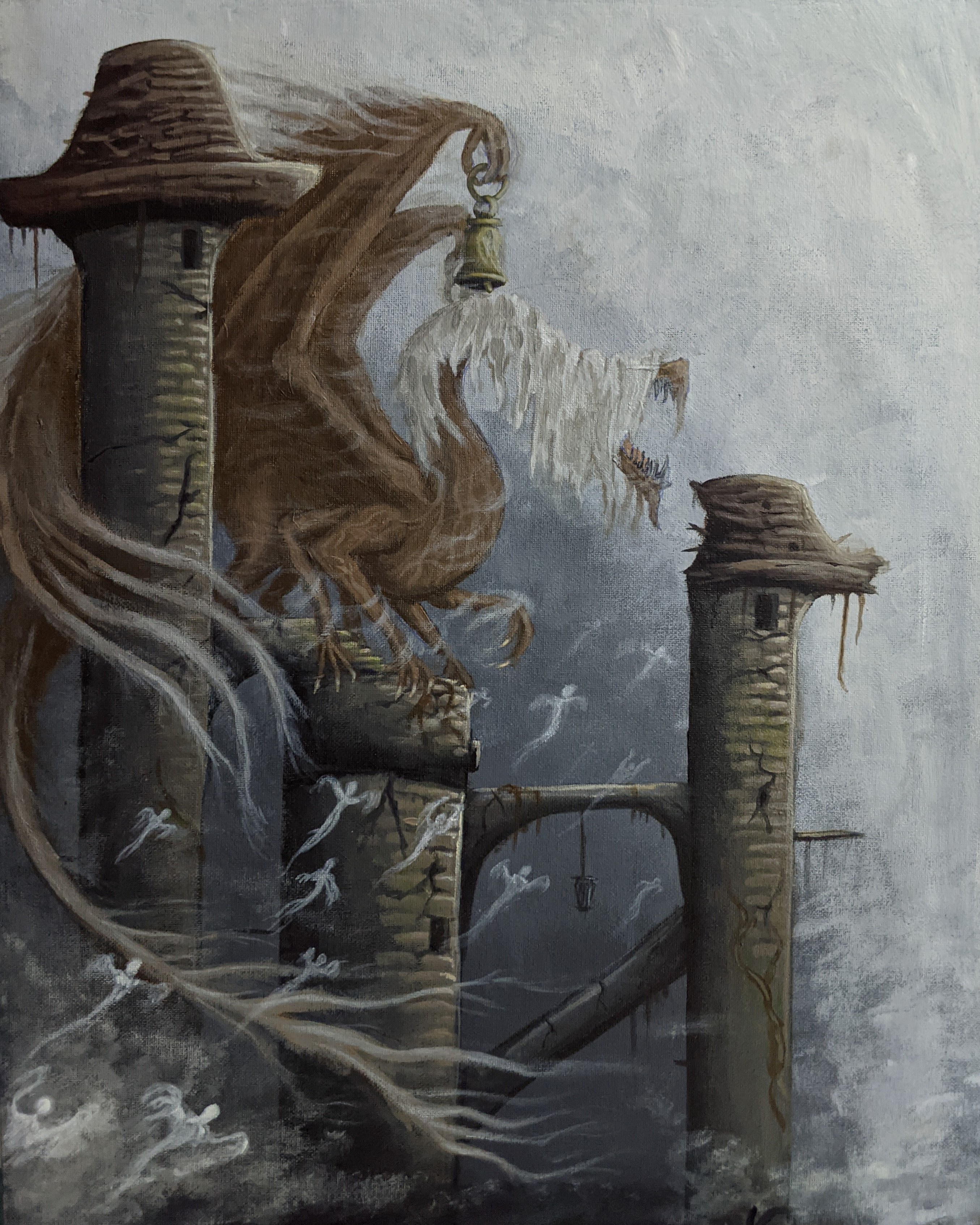
Neat! Check out his bio on our Artists page. Check the whole issue on November 30, 2021!
02 November 2021
Marvelous Meeting of Production!
Over the weekend we had a marvelous meeting of production! (Yes! I am trying to come up with a unique title.) At least 3 feline assistants were present, including a spooky black cat. Meow! Meow! Here, in the Rocky Mountain region, the weather was quite winter-y, however, so we decided to meet virutally (hence the cats). I may, or may not, have worn a witch's costume, but in no way is that indicative of my personality. :)
We had a nice discussion about all the stories and came up with six to-be-published, including one holiday story. We also had a nice discussion about art work and decided on a very neat piece. Stay tuned and I'll show you an art preview here later in the month.
Thus, all authors who submitted for the notable November 2021 issue should have heard back from us by now. Authors of accepted stories should have received an initial email from your editor, including a contract. Please send back the contract ASAP, so we can start working on your story! Yes, we are excited! I hope accepted authors will also take us up on the offer to blog--stay tuned for that, as well.
I did hear back from some authors already and very much appreciate their alacrity and enthusiasm! Woo hoo! Thank you, authors.
If you submitted a story, but it wasn't accepted: Thank you, author! We appreciate you, as well!
Starting next week, I'll start previewing the new issue here. Should be fun!
26 October 2021
behind the scenes
Whew! We are busy behind the scenes at Electric Spec. We had so, so many great stories submitted for this issue. If there was a slump in creativity brought on by the pandemic, it seems to be over. Yay!
If you submitted to us, you should have received an email by now saying either 'Stay tuned,' or 'Sorry, not this time.' Somehow, it seems like one or two submissions get lost in cyberspace for each issue. Not sure how or why this happens. So, to be clear, if you did not hear from us, we did not get your story. (Bummer!) Please consider resubmitting (for the fabulous first 2022 issue).
If you submitted to us, you should have received an email by now saying either 'Stay tuned,' or 'Sorry, not this time.' Somehow, it seems like one or two submissions get lost in cyberspace for each issue. Not sure how or why this happens. So, to be clear, if you did not hear from us, we did not get your story. (Bummer!) Please consider resubmitting (for the fabulous first 2022 issue).
What's next? All the editors are carefully considering the finalist stories and ranking them in order of preference. We have our production meeting coming up this weekend. No doubt, this will be a contentious knock-down, drag-out fight! Or not. :)
I'll let you know, next week.
19 October 2021
Short Story Workshop
Over the weekend, I presented a short story workshop at the Rocky Mountain Fiction Writers (rmfw.org) annual writer's conference. The workshop was a blast! The whole conference was a blast! :)
Consider joining, or creating, a local writer's group if you don't already belong to one.
Consider joining, or creating, a local writer's group if you don't already belong to one.
It was called "Writing Short: Focus on Short Stories."
There are many excellent reasons to write short fiction. Short stories are a great way to hone your craft. Short stories are a great way to get your name out there and get new readers. Short fiction is great for giveaways on your website or newsletter or for deals/ads. Short storeis are a great way to make some money--or not.
The craft section included discussions of characterization, plot, setting, emotion, theme, symbols, voice, mood, and style. The middle section was about marketing. A short story is a marketing asset. The final section was about different fiction publishers and rewards that aren't necessarily cash.
The bottom line is: short stories are valuable on many levels.
Good luck writing short!
Savvy writers know we closed to submissions for the notable November 2021 issue of Electric Spec! But don't worry; we're accepting subs for the February 2022 issue. Get those stories in!
For those who did get their stories in, we are hard at work behind the scenes...
I'll tell you more next week.
12 October 2021
To Flash Or Not To Flash?
The deadline for the awesome November 2021 issue of Electric Spec is coming up this week October 15, 2021. Get those stories in!
Over the last couple of years we have received more and more flash fiction.
What is flash fiction? Savvy writers know it is a short short story. Definitions vary, but in general, it's a story of less than 1000 words.
There are actually a lot of different terms for this including dribble, mini-saga, micro-fiction, drabble, micro-story, sudden fiction and others. It doesn't matter what you call it.
It's important to note that even though the story is short, it still needs all the elments of a short story including character, plot, emotion, and setting.
The most famous flash fiction, a six-word story, is attributed to Ernest Hemingway: For sale: baby shoes. Never worn.
There is no doubt this is a story with a lot of emotion because the reader brings a lot to it...
However, flash fiction is more difficult than standard short fiction. It's challenging to get all the story elements into so few words. At Electric Spec we have rarely published flash fiction because of this.
But, if you care to accept the challenge, go ahead and flash!
Good luck!
28 September 2021
Let's have a good author-editor relationship!
The deadline for the notable November 2021 issue of Electric Spec is coming up: October 15, 2021! Get those stories in!
As editors, we sincerely appreciate you sending us your stories. We also appreciate you following the rest of the rules we've set up, based on years of experience:
- send an rtf file in an attachment
- use standard manuscript formatting
- include a short cover letter in your email
- use the appropriate email address
- do not query us about your submission. Please recall we publish 4 issues per year, so we don't keep your sub for longer than 4 months maximum without contacting you. If you haven't heard from us within 4 months, something went awry.
- upon acceptance, please return the contract in a timely manner
- stay open to critique from your assigned editor. Please note we will not force any manuscript changes on authors.
- return your revised story in a timely manner
21 September 2021
Show me the story!
The deadline for the notable November 2021 issue of Electric Spec is coming up: October 15, 2021! Get those stories in!
This means we have started working on the new issue; specifically, we are going through the stories in slush. (Thank you for sending us your story!) Hopefully, if you're submitting to us, you read this blog at least occasionally. One of the things I've said is market is important. Luckily, it's easy to get a handle on this market. You can read previous issues of Electric Spec for free. Woo hoo!
Thus, for this market, we like some showing. I've read quite a few stories in slush lately that have little, or no, showing. Rather than exclusively telling me the story, show me the story! This means show the dialogue, thoughts, feelings, and action in the moment. Do not narrate everything for the reader. If I read a story that is exclusively narration, telling, with no showing, I will likely reject the story.
Good luck with your story!
14 September 2021
From Author Cleden
We're excited to feature "Phantom Limb" by David Cleden in the August 2021 issue of Electric Spec. Here's what the author has to say about it:
Thanks a lot, David!
Check out "Phantom Limb" and the rest of the stories in the awesome August 2021 issue!
The urban city setting for “Phantom Limb” could probably be any large city a few years hence, but it was actually inspired by London. At the time the story was written, I was working in central London and the streets, park and metro mentioned were all traced out (in my head, at least) based on real places. (The Soho Square area, to be exact). I’m pretty sure at some point on a lunchtime walk, the well-known Boomtown Rats song “I Don’t Like Mondays” must have been playing on my iPod and then I basically had all the ingredients I needed for the story.
The first draft was written on the morning commuter train into London. It amused me greatly that while my fellow passengers sat reading somber newspaper stories about declining share prices and the latest crisis being mishandled by the government, I was bringing havoc and mayhem to London’s streets. For a time I worried about fellow passengers shoulder-surfing my stories and wondering about the sanity of their fellow passenger, but if anyone ever noticed, it was never reported to the authorities.
Interestingly, in my many lunchtime walks around the area, I realized that area truly is the hub for post-production and video-graphics companies. I counted a dozen or so (including big name companies) all within a few blocks) and so somewhere along the way bits of the story started to fall into place. However, there are no surveillance drones patrolling London streets (yet) and I’m pretty sure the Metropolitan Police aren’t using the tactics described in the story.
For the record, I would also like to state that any chips that may have been inserted in my own head during this time were purely of the carbohydrate variety.
Thanks a lot, David!
Check out "Phantom Limb" and the rest of the stories in the awesome August 2021 issue!
07 September 2021
From Author Heynen
Hopefully, you've seen the awesome August 2021 issue of Electric Spec! We're excited to feature "Waking the Bear" by I.S. Heynen. Here's what the author has to tell us about the story:
Thank you, I.S.!
Check out "Waking the Bear" and the rest of the great stories!
This story is a retelling of the old Norwegian fairytale “East of the Sun, West of the Moon,” which my dad read to me several times as a bedtime story in early childhood—early enough that I only half-remembered it as an adult (“what was that story again? The one with the bear and the girl?”). I rediscovered it in 2020 after some Wikipedia sleuthing. I was going through a phase of obsession with myth/fairytale retellings at the time, and decided to develop a modern take on this cozy, folkloric Scandinavian odyssey.
My project started out nice, but grew more and more pagan and American Gods-ish the more I wrote. Before I knew it, I was researching old Saami animist beliefs and shamanism, and had somehow rewritten my favorite childhood fairytale to center around a sketchy human sacrifice.
This was also one of the first times I’d run a story through the Critters critique workshop’s gauntlet, a very humbling experience that connected me with about 20 different reader/reviewers who didn’t pull punches. Rewriting my already-bizarre story afterwards turned out to be one of the trickiest writing exercises I’ve tried this year.
A huge thank-you to Electric Spec for selecting my work! It’s an honor to be featured here.
Thank you, I.S.!
Check out "Waking the Bear" and the rest of the great stories!
31 August 2021
Thanks a lot!
Huzzah! The awesome August 2021 issue of Electric Spec is live!
We need to thank our excellent cover artist and authors. Hurray for our creatives!
We need to thank our excellent editors and tech staff. Thank you for all your hard work!
And most of all, we need to thank our readers! Woo hoo! We wouldn't exist without you!
Thank you, everyone!
From Author McCabe
The awesome August 2021 issue of Electric Spec is live! Woo hoo!
One of the stories we are excited to feature is "A Thousand Ways" by Beth McCabe. Here's what the author has to tell us about the story:
Thank you, Beth!
Check out "A Thousand Ways" and the rest of the brand new stories!
One of the stories we are excited to feature is "A Thousand Ways" by Beth McCabe. Here's what the author has to tell us about the story:
I'd like to give a nod to the late, great Robert Heinlein for the inspiration for my portrayal of Riley, the protagonist of my story "A Thousand Ways."
When I was a kid in the middle of the last century, my mom often dropped me off at the town library after school. At the time I assumed she just wanted me out from underfoot, worried as she always was about performing her household duties up to that era’s oppressive standards.
Later I understood that she was also sharing a gift with me: her love of reading. (She hid her own library books under the toaster cover, as Dad considered her reading for pleasure "wasting time").
During those long afternoons I roamed the dusty stacks, pulling out any volume that looked interesting. With no adult guidance (thank goodness), I didn't know there were rigid sets of girls' books and boys' books. And so I fell across Heinlein's Juvenile Novels--what we would now label as YA.
That was it for me: I knew I was meant to read, and write, speculative literature.
It's true that Robert H. could only envision boys as main characters in his adventures. And at least one of his books was serialized in Boys' Life, a Boy Scout publication, effectively bypassing young female readers. (I like to picture some of those boys' sisters innocently saying, "What magazine?", then following a Heinlein adventure under the covers with a flashlight.) But his books still spoke to my inner girl nerd, an entity that had scant reinforcement in that time and that place.
One of my favorites was Farmer in the Sky. In this book, a family emigrates from a dying earth to the Jovian moon Ganymede, which they have been told is a fertile farm colony. I vividly remember the immediacy and verisimilitude of teen-aged Bill's new environment. In spite of the fact that little was known about this moon--which just gave Heinlein's prodigious imagination more leeway--I was right there on Ganymede with Bill.
When I set out to write "A Thousand Ways," Riley was very clear with me about how to tell her story. I had to make people not just see, but feel what a first-generation Martian kid would feel. How the challenges of adolescence--sibling rivalry, an unrequited crush, an existential threat to her community--would play out just as it would for an Earth kid. But, although one-third g, dust storms, and a cramped underground habitat would be an alien environment for us, to Riley, it's simply home.
No matter what planetary body it's on, there's no place like it.
My thanks to the Electric Spec editorial team for giving Riley her voice. It's great to join this talented group of authors and editors.
Thank you, Beth!
Check out "A Thousand Ways" and the rest of the brand new stories!
24 August 2021
From Author Sherwood
In the awesome August 2021 issue of Electric Spec we're pleased to feature
Jonathan Sherwood's story "Shaytandokht." Here's what he had to say about it:
I would like to preface this post by saying that my story, "Shaytandokht," which is set in Afghanistan, was written and accepted before the recent terrible events unfolding in that part of the world. It is not a commentary on the current crisis, and I don't pretend to have any insight into it. It's merely a coincidence.
Thanks, Jonathan! Very interesting!
Be sure to check out "Shaytandokht" and the rest of the stories on August 31!
I would like to preface this post by saying that my story, "Shaytandokht," which is set in Afghanistan, was written and accepted before the recent terrible events unfolding in that part of the world. It is not a commentary on the current crisis, and I don't pretend to have any insight into it. It's merely a coincidence.
"Shaytandokht" is one of the most difficult stories I've ever written, but it's also one of my favorites.
The story is set in the frozen desert of modern Afghanistan, and the title refers to the Farsi name of a woman named Shaytandokht (pronounced "set-on-doh-hut"), who a few locals say is the daughter of the devil.
The story consists almost entirely of three men walking across the desert, just talking. But what made the piece so difficult to write is that two of the three men don't speak the same language and rely on the third man to translate between them. And none of them are named, so ensuring the reader knows who is talking means leaning heavily on each man's individual mannerisms.
Doing that became complicated by the fact that I wanted the piece to have the feel of an allegory, so I used very sparse and simplistic phrasing throughout.
I outline my stories in great detail before I write, so the first draft of "Shaytandokht" took only a few hours, but the revision took days because so much depended on the individual word choices. The rhythm of the language had to reflect the stilted nature of the three men's somewhat adversarial relationships, so I was constantly replacing words that either felt too expressive for the trio or (for lack of a better word) civil.
One of the trickiest aspects was illustrating the men's individual personalities. For instance, when the non-English-speaking man relayed something, he would display certain mannerisms relating to what he said. But the guide, who would normally just translate the first man's words into English, would sometimes have his own reactions to the man's words, so every aspect of the ongoing conversation would be colored by the guide's own word choices. It became extremely difficult to create that constant juxtaposition of the original words and the speaker's mannerisms, and the guide's translation and his reactionary mannerisms. Hopefully, the reader will never notice any of that, but trying to make it transparent took more time than the entire initial draft took to write.
Probably because of all the effort to hide the complexity, "Shaytandokht" is one of my densest pieces. At 2,100 words, it's quite short, but I think it packs more punch per word than anything else I've written, and even though we barely get to know the characters in that short time, I secretly like them all.
I do hope you enjoy "Shaytandokht" as much as I enjoyed writing it.
Thanks, Jonathan! Very interesting!
Be sure to check out "Shaytandokht" and the rest of the stories on August 31!
17 August 2021
From Artist Quinn
We're exited to feature "Lady of the Sword" by Brian Malachy Quinn for the awesome August 2021 issue of Electric Spec. Brian tells us about the piece:
"Lady of the Sword" is one in a series I did of lady knights. Beautiful women that are also lethal. I tend to do series with a general theme – whatever is causing the neural synapses of my brain to fire. Like when Covid hit in March of 2020, and I did, I think seven lion paintings (some quite large) to avoid watching the mounting body count as we entered the Apocalypse. For my speculative art, I try to put some time and effort into the backgrounds to make them memorable, but I think I bit off more than I could chew with this one as I spent way too much time on the background of this one.
Thanks, Brian! Very interesting!
And without further ado, here's a sneak peek:
"Lady of the Sword" is one in a series I did of lady knights. Beautiful women that are also lethal. I tend to do series with a general theme – whatever is causing the neural synapses of my brain to fire. Like when Covid hit in March of 2020, and I did, I think seven lion paintings (some quite large) to avoid watching the mounting body count as we entered the Apocalypse. For my speculative art, I try to put some time and effort into the backgrounds to make them memorable, but I think I bit off more than I could chew with this one as I spent way too much time on the background of this one.
Thanks, Brian! Very interesting!
And without further ado, here's a sneak peek:
10 August 2021
From Author Pillard
We have a lot of great stories coming up in the awesome August 2021 issue of Electric Spec! One we are excited about is
"The Promises of Sisters" by J.C. Pillard.
Here's what J.C. had to tell us about it:
Thanks J.C.! Very interesting!
Here's what J.C. had to tell us about it:
I don’t write about siblings. That probably sounds deeply ironic, coming from the author of a story called “The Promises of Sisters,” but it’s true. Like many fantasy authors, I end up with a lot of orphans and only children. It’s hard to go on magical adventures when your sibling wants to come, too.
I do, however, have two sisters. I’m the oldest of three, and my sisters have profoundly shaped me as a person. They regularly challenge and infuriate me, and they support me even when I can’t support myself. Such is the power of siblings. They also read my writing regularly, although hilariously, they won’t read this story until it comes out (hi Emily and Aly!).
When I began writing "The Promises of Sisters," the working title was "What It Means to Burn," and it was merely about a young woman who went to the land of the dead and then returned. But you can’t send someone to the land of the dead without a good reason, and I was struggling to find that reason for my protagonist.
It can be a hard thing, as a writer, to have an idea for a story and have that story take you in a completely different direction. So it was with this tale. While I was trying to walk the land of the dead, my protagonist was trying to get to her sister, and she wouldn’t rest until I’d added that sister into the story. As usual, the writing knew better what it needed than I did myself. The sister stayed, and the story unfurled from there.
When it came time to write the ending, though, I was challenged yet again. I don’t want to give anything away here, but I will simply say that sisterhood works both ways. I’m sure I infuriated my siblings just as much as they did me, and I know they love me as much as I love them. Love is not a straightforward road, and sisters will be pulling each other’s hair one minute and walking the paths of the dead for each other the next. Metaphorically, at very least.
Thanks J.C.! Very interesting!
03 August 2021
Production Meeting Notes
We had a great Production Meeting for the awesome August 2021 issue of Electric Spec. We did end up meeting virtually which meant all of our feline assistant editors were able to attend. Meow! (What is it about cats and virtual meetings?!)
We had a large number of wonderful stories to choose from. Yay! We had trouble deciding, so ended up picking six stories. Yes, this is unusual!
We had a large number of wonderful stories to choose from. Yay! We had trouble deciding, so ended up picking six stories. Yes, this is unusual!
Thus, all authors have, or will soon, hear from us regarding the disposition of submitted stories. 'Yes' authors should have, or will soon, receive a contract. As soon as we get those back, we start editing stories. Some editors think this is the funnest part of being an editor--helping make stories even better.
Our tech team has already starting creating the issue on the website. We are looking forward to getting blog entries from authors/artists for this very blog.
So, stay tuned for more Electric Spec info right here!
27 July 2021
Working Hard
Just a couple of lines, so we don't break our blogging streak. :)
We are working hard on the Awesome August 2021 issue of Electric Spec.
Next week I'll report on the Production Meeting!
I better get back to work...
20 July 2021
Welcome, Bonnie!
Starting with the awesome August 2021 issue of Electric Spec we have a new Associate Editor, Bonnie Ramthun!
Bonnie Ramthun is a Colorado mom, wife, and novelist. Her novels for adults include the detective Eileen Reed mystery series of Ground Zero, Earthquake Games, and The Thirteenth Skull. Her middle grade mystery series includes The White Gates, Roscoe, and Haunted Waters. The White Gates, published by Random House, was a Junior Library Guild Premiere selection and a finalist for the Missouri Truman Award. She is a former chapter president of Mystery Writers of America, a member of Rocky Mountain Fiction Writers, and a former war gamer for the Department of Defense.
Welcome, Bonnie!
Subscribe to:
Posts (Atom)

 Posts
Posts

