30 August 2012

We're Live!

The awesome new issue of Electric Spec is live! Go check it out!
Thank you very much to everyone who helped us put this one out including authors Andy Goldman, James Bizzel, Joe Ollinger, Simon Kewin, Linda Hilburn, and this time Nikki Baird! Woo hoo! Thanks to our cover artist, Laura Givens. Thanks to all the editorial and technical staff.

And for those of you who submitted stories and didn't make it into the issue: Thank you to you, too!

Especially, thank you, Readers!

28 August 2012

Get Ready!

Readers, get ready! Start your, uh, spectacles? E-readers? I guess start whatever you want to start. This week we will release our new issue of Electric Spec! Some highlights include:

As Dave recently alluded to, there's lots of awesome fiction! In the fantasy sub-genre, we have "My One and Only" by James Bizzell, which uses an unique story structure to explore the question of just what is a soul mate. Also in fantasy, Simon Kewin brings us "The Chronicles of Zer" which emphasizes the importance of books being read. In the cyberpunk department, we have "False Negative" by Andy Goldman, which reminds us the spam in our inbox isn't nearly as bad as it could get. Another late summer thriller for sci-fi readers is Joe Ollinger's "10,000 Bones", an extraterrestrial noir tale that will shake you to your . . . er, bones.

And as if all that wasn't enough, in Special Features, we offer an interview with vampire writer Lynda Hillburn, of Kismet Knight fame. And finally, we're excited to present a new addition our Editor's Corner: our awesome associate editor Nikki Baird shares with us the unique romantic fantasy, "The Hundred Year Storm." Combine that with dramatic cover art and you have a super-fantastic ezine issue! W00t! :)
I admit I may not be totally objective.

Check it out this week!

24 August 2012

New Issue Almost Here!

We're putting the final touches on our August issue, which comes out one week from today. To whet your appetite, I'll mention that one of the stories I edited was unique not just in its plot, but also in its structure. Really cool how the events in the story mirror the structure of the story itself. (Okay--I won't keep you guessing. It's James Bizzell's "My one and Only.") I'm also excited because we have a great story from one our favorite E-spec authors, Simon Kewin. I believe this is Simon's forth story with Electric Spec!

21 August 2012

writing tips from writers

Many of you may have seen this already but BuzzFeed has a nice collection of "30 Indispensable Writing Tips From Famous Authors". For our writers, here's a nice sampling:
  • If it sounds like writing, I rewrite it.--Elmore Leonard
  • Don't tell me the moon is shining; show me the glint of light on broken glass.--Anton Chekhov
  • If it is possible to cut a word out, always cut it out.--George Orwell
  • Kill your darlings, kill your darlings, even when it breaks your egocentric little scribbler's heart, kill your darlings.--Stephen King
  • Remember: when people tell you something's wrong or doesn't work for them, they are almost always right. When they tell you exactly what they think is wrong and how to fix it, they are almost always wrong.--Neil Gaiman
  • A short story must have a single mood and every sentence must build towards it.--Edgar Allan Poe
  • Start as close to the end as possible.--Kurt Vonnegut
Read all the tips here.

In other news, our fabulous new August 31, 2012 issue of Electric Spec is coming along swimmingly! Be sure to check it out next week!

17 August 2012

a couple good links

We interrupt our regularly scheduled broadcast for two neat links.

On Writers in The Storm Blog, Kristen Lamb explains What Star Trek Can Teach Us About Great Writing--the 2009 J.J.Abrams movie. Electric Spec readers and writers should enjoy topics such as

  • Star Trek proved that imperfect characters resonate with audiences.
  • Star Trek perfected showing, not telling.
  • Star Trek employed parsimony.
  • Star Trek showed character via relativity.
  • Star Trek relied on character and story.
  • World-building is something a writer must employ to assist or accentuate the core conflict.
There's lot of good advice here!

The president of Rocky Mountain Fiction Writers (RMFW), Mark Stevens, talks about Tall Tales: Rocky Mt. Fiction Writers Conference in Denver. I agree with Mark. The RMFW conference is awesome! Check it out Sept. 7,8,9 2012 in Denver if you can.

14 August 2012

behind-the-scenes update

We, The Editors, are in the thick of things, getting ready for the new issue of Electric Spec. Personally, I finished my initial edits of my two assigned stories, and passed things off to the authors for their feedback.
What the heck? I'll tell you about them (because they're both really good). "False Negative" by Andy Goldman is a disturbing extrapolation of what could happen if human beings have to deal with their selves being spammed. "10,000 Bones" by Joe Ollinger is a tale of disillusionment and human greed--set on another planet, of course. Yes, these are both science fiction. I do tend to edit the most science-fiction-y of our stories because I'm a scientist. :) Read the new issue on August 31, 2012!

We also have something new in the upcoming issue: a story by our Associate Editor, Nikki Baird, in Editor's Corner. For those of you who don't troll the obscure webpages of Electric Spec,
Nikki Baird writes science fiction, fantasy, and horror. Her short horror story, "Devastation Mine" was published as part of the anthology Broken Links, Mended Lives, which was nominated for a Colorado Book Award. She has been a finalist in the Rocky Mountain Fiction Writers' Colorado Gold contest for the last two years in the Speculative Fiction category, and is a regular contributor to writersonthebrink.com. Read more about Nikki here. So, be sure to check out her story, too!

In other news...we have been neglecting the slush pile. :(
Sorry. We'll get back to it soon. If you've submitted: hold on!

07 August 2012

partnership

Once in a while we get an author who doesn't want us to edit their story or they don't want to sign the contract or they want us to edit their story before they sign the contract or similar. What happens when this occurs? The author doesn't get published. Personally, I find such situations quite sad. The author has gone to the trouble to write a good story but hasn't gone to the trouble to learn about the publishing business. Editors never work with content without a contract.

It's particularly sad with regard to Electric Spec because we created the 'zine with the sole purpose of helping authors. All the editors are writers and love fiction and we all know how tough the publishing market is. We want to help you get your best work out there for the reading public! When we edit a story we always work with the author in partnership to create the best story possible.

We're now accepting submissions for our November 2012 issue. Check out our Fiction Submission Guidelines where it says before publication we may edit the story for length or readability. However, we always remain true to the spirit of the story.

Good luck! :)

03 August 2012

production meeting

My head has finally stopped pounding enough to give you all an update. We, The Editors of Electric Spec, had our production meeting this week. We had a super-duper special guest: our associate editor Nikki Baird. Thanks for all your help, Nikki! Plenty of fun and excitement and refreshments and arguments were had by all. I admit the caber toss was probably a mistake. One of us (okay, it was me) had 8 different kinds of beer! Possibly writing the blog post about the production meeting isn't quite the high honor my fellow editors and the beer goggles may have led me to believe...

Anyway, we are smack dab in the middle of the process of emailing the authors in hold-for-voting to tell them the big news. Stay close to your inbox if you're waiting for 'yeah' or 'nay'. If you didn't make it in the issue: thank you for submitting--we appreciate it. If you did make it in: Congratulations! We will start editing the stories as soon as we get the contracts back. What else? We plan on five neat stories in this issue. We have a neat story planned for Editors Corner. Editor Betsy will do a neat author interview. We have neat cover art. Apparently, I use the word 'neat' too often. :)

There were some spirited discussions about which stories to include. What was the tie-breaker? Originality. If there was a story that included a plot idea or a world or a story structure we hadn't seen before, it had a better chance. If we couldn't predict where the story was going, it had a better chance. We also did have to address the question of issue balance: we could not have 5 stories about love triangles involving a mopey human, a vampire, and a werewolf. Darn!

Please check out the new issue of Electric Spec on August 31, 2012!

31 July 2012

stay tuned...

This week things are cranking into overdrive behind the scenes at Electric Spec. We have our production meeting and will pick stories for the August 31, 2012 issue. So, stay tuned until later in the week and we'll post more.
We're also gearing up for the thirtieth annual Rocky Mountain Fiction Writers Colorado Gold Conference September 7-9. We, the ElectricSpec Editors, will be teaching a short story workshop among other things. I highly recommend this conference and there's still time to register, although some events are booked up. Read more about it here.

In the meantime, for your reading pleasure, Professor Gunn pointed me to a fun article in the New York Times Sunday Book Review: How to Write by Colson Whitehead. It has some good advice and some which is good for a laugh. :)

24 July 2012

is your story memorable?

Here at Electric Spec we are very busy behind the scenes working on the next issue: August 31,2012. What's going on, you ask? Well, I'll tell you. :)

We've scheduled our production meeting for next week. Some of us are frantically trying to get through their slush. Some of us are already pondering the relative merits of the stories in hold-for-voting. We're thinking about possible movie columns, entries in Editor's Corner, cover art and author interviews. We're setting up the issue in our content management system. If it seems like a lot of work, it is.

I find picking amongst the stories in hold-for-voting to be hard. In the first place, if a story gets in hold-for-voting it is publishable. So, it's tough to think that we might end up not choosing it; I definitely empathize with authors. Not only is writing difficult, getting published is difficult. In fact, this is why we started Electric Spec--to give authors another possible market. I've been trying to pinpoint what makes me prefer a story in hold-for-voting over other stories. Yes, it has to be well-written with an intriguing protagonist that does something. Yes, there has to be some kind of interesting speculative fiction element like a neat new world. I think the extra something is being memorable. After I read the story, does it stick with me? Do I ponder it on my commute? That's a story I'm going to pick.

Of course, the next question is: how do you make a story memorable? Writing is an art so there are no tried-and-true formulas. But you might consider a never-before-seen world or a unique character with a one-of-a-kind problem. Nailing the character's point-of-view also helps; if I feel like I am the character, that's more memorable. Good luck!

Do you have any tips for writing a memorable story?

17 July 2012

science geek-out

Maybe it's the influence of Comic Con, or maybe it's just too hot outside to think straight, but I'm a geek and proud of it. Along those lines, there's been some really exciting and interesting announcements in the world of physics in the past year. The Oscillation Project with Emulsion-tRacking Apparatus (OPERA) Project in Italy announced they'd measured neutrinos traveling faster than the speed of light. If true, this would have been beyond shocking. Of course, this was disproved when they turned out to have systematic errors... But it's still good story fodder. :)

Lately, a discovery that appears to be true is the discovery of the Higgs Boson at the Large Hadron Collider (LHC) at the European Organization for Nuclear Research (CERN). I studied the Higgs Boson while I was young and impressionable. What you need to know is bosons are the particles that mediate or carry forces. To use an example you might have heard of, photons are the bosons of the electromagnetic force field. In other words, photons carry electromagnetism. So, the Higgs Boson works like this: it mediates or carries a force, namely, the Higgs field. The Higgs field is basically the field that gives particles mass. Cool! Again, there are a lot of story possibilities here.

Recently, I found a neat blog that discusses such topics: Quantum Diaries: Thoughts on work and life from particle physicists from around the world. This site is (mostly) comprehensible to normal folks. They have a ton of stuff on the Higgs Boson and what the big deal is. I particularly liked the post from last week on Dark matter: No model, just guesses. Enjoy!

11 July 2012

WorldCon

No doubt some Electric Spec readers are busy getting ready for, or traveling to, Comic Con 2012. (Please feel free to drop us a comment about your experience.) But also coming up this summer is the 70th World Science Fiction Convention in Chicago, August 30 to September 3, 2012. The is the preeminent world-wide conference for Science Fiction and Fantasy. One of the Electric Spec Editors will be there (I'll let s/he tell you about it him/herself).

Of course, one of the best things about WorldCon is you get to vote for the 2012 Hugo awards, and that means you get free electronic copies of most of the works. Nominees for the best short story include:

  • “The Cartographer Wasps and the Anarchist Bees” by E. Lily Yu (Clarkesworld, April 2011)
  • “The Homecoming” by Mike Resnick (Asimov's, April/May 2011)
  • “Movement” by Nancy Fulda (Asimov's, March 2011)
  • “The Paper Menagerie” by Ken Liu (The Magazine of Fantasy & Science Fiction, March/April 2011)
  • “Shadow War of the Night Dragons: Book One: The Dead City: Prologue” by John Scalzi (Tor.com)
Congrats to all the nominees.

Personally, I've only been to one WorldCon and that was when it was in Denver in 2008. It was very awesome and very crowded. There were tons of programs and parties and panels. A highlight for me was the SFWA suite, where I volunteered. It was neat seeing and rubbing elbows with all the stars of the SF/F world. In particular, I seem to recall Editor Betsy sitting on George R.R. Martin's lap...

Anyway, I bring all this up because

  1. You should go! and
  2. Author guest of Honor Mike Resnick has posted his Worldcon--A Beginner's Guide
He gives at lot of really helpful information, so check it out. And if you go, have fun and keep and eye out for Electric Spec!

09 July 2012

guest post: Renata Hill

Today, we're pleased to have a guest post from one of Electric Spec's founding editors: Renata Baron Hill. Among Renata's many talents, she is an excellent editor. She shares one of her tricks with us...

When I’m up at two in the morning, typing a promised post for a blog, or for that matter, two in the afternoon writing a query letter or, more likely, responding to a Facebook IM, sometimes I rush to click Publish or Send without reviewing my work. Say, what? Yes, it happens, particularly if I have not devoured my daily ham-and-cheese Lunchable.

Now, Ginger, a nifty FREE download from Ginger Software helps me out. Sure, it checks spelling, but among its coolest features is the homophone checker. I’ll give you a hint if you were sick that day in sixth-grade English: homophones are words that sound the same, but have different spellings and meanings. So, when I suggest to my online friend, “Let’s grab a bear after work,” Ginger understands the context and automatically corrects my sentence to, “Let’s grab a beer after work.” Now, my friend knows that I don’t want to don camo, but actually quaff a delicious malty beverage.

Plus, for all you harried writers out there, Ginger also checks subject/verb agreement, singular/plural nouns, consecutive nouns, and basically makes you sound more like Arthur C. Clarke than Arthur Dent. Try it. There are no strings, no secret malware, and it works for PCs and Macs.

Renata, a founding editor, recently switched to a new medication that has enabled her to better appreciate the rich weirdness of China MiƩville's novels, the complex settings of Frank Herbert's earlier worlds, and the strange, feminist-loves-phantasm themes in the works of Laurell K. Hamilton. When not researching obscure marketing facts about Fords for wealthy corporate clients or writing scintillating software documentation for moody SQL developers, she adores reading the genres of fantasy, science fiction, alternative history, and the macabre. She was first published at the tender age of 6, spent adolescence and young adulthood plumbing the depths of life's ironies in short story form and non-fiction articles, and some day hopes to nestle into the mantle of "famous novelist".

03 July 2012

perfection

I've been writing and rewriting a story for several weeks now. And I keep begging my critique partners to take "just one more look" at it. Frankly, at this point, I'm surprised they haven't shot me, or pushed me into one of the wildfires. I'm dragging my feet about submitting it to the market I wrote it for because I know the editor won't change it. It has to be perfect when I send it in or she won't buy it. :(

But you are in luck. We, the editors of Electric Spec, do work with authors to make stories the best they can be. They don't have to be 100% perfect when you send them in. That should be a bit of a relief for you all. What's the most common thing we do? Besides spelling and grammar issues, we often end up shortening a story. Short stories, in particular, need to be as short as possible to tell the story. :) Yeah, I know, easier said than done.

Speaking of perfection, the awesome writer and writing teacher Kristine Kathryn Rusch, has a really nice article posted on her website: The Business Rusch: Perfection. Ms. Rusch basically says no story is ever perfect to every reader. So, at some point, quit sweating it and send it in! Good advice.
By the way, Ms. Rusch is an excellent resource for writers. Check out her archive of 'On Writing' posts.

Oh, and FYI, we close to submissions for the August 2012 issue on midnight July 15, 2012 (U.S. Mountain Daylight Time). So you still have time to send your story in. :) Good luck.

28 June 2012

Notes from the Slush Pile

The Electric Spec editors have posted before about the importance of the first page--even the first paragraph--of a story. The reality is that we have lots of submissions to go through and if we're not impressed with the beginning, we may never get to the end. I wish I had the formula for the perfect story opening, but I don't. However, here are three things I've seen in the first paragraph that have made me want to look at the next story in the pile:

1) Passive voice--especially multiple sentences in a row of passive voice.
2) Lack of a clear protagonist. This usually means there's a long narrative that reads more like a newspaper article than a story. Also, this can be when multiple characters are introduced but I don't know which one the story is about.
3) Generalized descriptions. For example, "The short-haired man stood in the room. Across from him, the woman sitting in the chair smiled." I don't get a picture in my head from these sentences. I don't even know where or when the story takes place. Give me some details. Maybe something like this: "As usual, Alfred, the raisin-faced weirdo from accounting, hovered next to the coffeemaker in the break room. Jane slouched in the hard plastic chair across from him and couldn't help but smile. Tonight, Alfred would die a slow, painful death."

26 June 2012

Greatest SF/F Authors?

There was an interesting article posted on flavorwire at the end of last week: The Greatest Female Sci-Fi/Fantasy Authors of All Time. It was in honor of the late Octavia Butler's birthday. Here's the list:
  • Ursula K. LeGuin
  • Octavia Butler
  • Madeleine L’Engle
  • Angela Carter
  • Kelly Link
  • Anne Rice
  • Connie Willis
  • Susanna Clarke
  • Doris Lessing
  • Marion Zimmer Bradley
These authors are amazing. :) What do you think?

I must admit I do have a problem with the "greatest female" label. I'd say most of these authors are among the "greatest" authors period, certainly in the SF/F field.

Generally the "of all time" label is also a bit problematic. Authors can be amazing trail-blazers or ground-breakers for their time, but have their work not stand up years or decades later. (Not that I'm saying this is the case for these authors.) Should we judge authors in their time or for all time?
Tricky.

What do you think? Who are the greatest SF/F authors?

14 June 2012

Betsy's Schedule at Denver ComicCon

June 15-17  Denver ComicCon Schedule!!!


  • Local Authors Spotlight - Hyatt Capitol Room 3 - 7pm FRIDAY
  • New Horror and Urban Fantasy - Room 104 - 11-12 Sat SATURDAY 
  • Strong Women Writers and Characters in SF and Urban Fantasy - Hyatt Capitol Room 2  2pm SATURDAY
  • Great SF/fantasy/horror books  Room 104 - 10-11am SUNDAY 
  • How To Break Into SF/fantasy/horror Fiction-Writing - Room 104   11am-12 SUNDAY

12 June 2012

notes from the slush pile

We've started going through the slush pile for our next fabulous issue of Electric Spec. (Thanks for your submissions!) I do have some advice for aspiring Electric Spec authors. Savvy blog readers will realize I've said some of this before.
  • Do avoid exclamation marks! When I got my MFA my professors told me authors are allowed one exclamation mark per 80,000-word novel. How many does that leave you as a short story writer? You do the math.
  • Do have your protagonist do something. In particular, it's great when the protagonist acts to solve his/her/its problem.
  • Do give your protagonist a problem. If his/her/its life is perfect...it's not a story.
  • Do have some dialogue. Obviously, you can write a story with no dialogue, but we rarely publish such stories. Be cognizant of your market.
  • Do avoid non-said dialogue tags. 'asked' is okay, too.
  • Do have at least one speculative fiction element. I just rejected a lovely story solely because there was nothing speculative about it. Be cognizant of your market. :)
  • Do avoid obvious and blatant political or religious issues. We don't campaign for candidates or causes. We don't proselytize.
  • Do avoid grammar and spelling issues--especially in the first paragraph. We may be a little lenient when it comes to accepting stories with grammar and/or spelling issues but when they're in the first paragraph, I get grumpy.
  • Your advice here.
That's all I can think of for the moment. What do you think?

06 June 2012

R.I.P. Ray Bradbury

As most of everyone has heard by now, author Ray Bradbury passed away last night in L.A. This is a significant loss to world culture. Of course, some of his most famous works include The Martian Chronicles, and Fahrenheit 451. I think Fahrenheit 451 is one of the most prophetic novels ever written. It's also the most scientific. Bradbury himself said Fahrenheit 451 was his only true science-fiction work; the others were fantasies despite their settings (such as Mars!). There's no question Bradbury liked to tell stories, but also like to make readers think.

As Clifton Fadiman says in one edition of The Martian Chronicles Prefatory Note: "Mr. Bradbury has caught hold of a simple, obvious but overwhelmingly important moral idea... That idea--highlighted as every passing month produces a new terrifying lunacy: sputniks,super-sputniks, projected assaults on the moon, projected manned satellites--is that we are in the grip of a psychosis, a technology-mania, the final consequence of which can only be universal murder and quite conceivably the destruction of our planet." Bradbury's paradigm was very different from those of his science 'fictioneer' peers. Since humanity has not heeded his warnings, let's hope his dire prophesies do not come to pass.

There's a fascinating interview about Bradbury posted at The Paris Review: Ray Bradbury, The Art of Fiction No. 203. Check it out!

Rest in peace, Mr. Bradbury.

05 June 2012

Check it out!

I hope you've already checked out the awesome new issue of Electric Spec. In case there was something you missed, here's a run-down of its excellent-ness. (Yes, editors are allowed to make up words.)

What's the key to kicking off a great summer? Great speculative fiction stories! And we just happen to have several you are sure to enjoy. Returning Electric Spec author A.L. Sirois brings us a startling look at the future of musical entertainment in "Itinerate Pandemonium." Those who love high fantasy will flock to "They Who Ride Griffons" by K.R. Hager. Also in the fantasy department, we bring you Larry Hodges' "In the Belly of the Beast," which presents a whole new take on dragon hunting. If you're looking for a note of tragedy with your sci-fi, read "Time Debt" by D. Thomas Minton. And, just in time for summer, we have "Deep Deep" by Karen Munro, a summer camp story with a side of slipstream. If any of you are planning a trip to Vegas, you may want to read the cautionary tale included in this month's Editor's Corner "My Kingdom for a Gislestorch". As if all this fiction were not enough to get you going, this issue features an exiting interview with first-class science fiction author Warren Hammond, and our film critic explains how the horror film A Cabin in the Woods relates to world politics.

Thank you very much to all our authors and columnists, our tech support folks, our slush reader and everyone else who helped put this issue together. We appreciate you!

And "Thank You" readers! Without you, we wouldn't exist!

29 May 2012

new issue May 31!

We're almost ready to go live with an exciting new issue of Electric Spec! Check it out on May 31, 2012! We have six brand new entertaining speculative fiction stories for your reading pleasure. A.L. Soris shows us the surprising future of entertainment in "Itinerate Pandemonium". K.R. Hager gives us "They Who Ride Griffons" for a high fantasy thrill ride. Larry Hodges tells the tale "In the Belly of the Beast"--you've never seen dragon-hunting like this. D.Thomas Minton uses time dilation to tragic effect in "Time Debt". Karen Munro scares us with "Deep Deep"; let's just say you may be reluctant to let your kids go to summer camp this year. And, finally, editor David E. Hughes gives us a humorous and unique take on an urban myth in "My Kingdom for a Gislestorchen".

We also have a fascinating interview with neo-noir SF author Warren Hammond. I teased you about it earlier here. And our film critic Marty Mapes discuses A Cabin in the Woods, relating it to... You'll just have to read it to find out. :)

22 May 2012

Advice from Gaiman

We're nearing the home stretch on the new Electric Spec issue. Check it out May 31, 2012!

I'd meant to post the 2011 Nebula Award Winners as I am wont to do. So here they are:

  • Novel Winner: Among Others, Jo Walton (Tor)
  • Novella Winner: ”The Man Who Bridged the Mist,” Kij Johnson (Asimov’s Science Fiction, October/November 2011)
  • Novelette Winner: ”What We Found,” Geoff Ryman (The Magazine of Fantasy and Science Fiction, September/October 2011)
  • Short Story Winner: ”The Paper Menagerie,” Ken Liu (The Magazine of Fantasy and Science Fiction, March/April 2011)
  • Ray Bradbury Award for Outstanding Dramatic Presentation Winner: Doctor Who: “The Doctor’s Wife,” Neil Gaiman (writer), Richard Clark (director) (BBC Wales)
  • Andre Norton Award for Young Adult Science Fiction and Fantasy Book Winner: The Freedom Maze, Delia Sherman (Big Mouth House)
  • 2011 DAMON KNIGHT GRAND MASTER AWARD: Connie Willis
Congratulations to all the winners! Read more about it over at SFWA.

But speaking of Neil Gaiman, in the meantime, I got very distracted by his May 17 excellent commencement address at The University of the Arts. Here are the bullet points:

  1. When you start out on a career in the arts you have no idea what you are doing.
  2. If you have an idea of what you want to make, what you were put here to do, then just go and do that.
  3. When you start off, you have to deal with the problems of failure.
  4. I hope you'll make mistakes. If you're making mistakes, it means you're out there doing something.
  5. While you are at it, make your art. Do the stuff that only you can do.
  6. So make up your own rules.
  7. So be wise, because the world needs more wisdom, and if you cannot be wise, pretend to be someone who is wise, and then just behave like they would.
Check out the entire thought-provoking, encouraging speech here.

08 May 2012

in the slog

We, the editors, are deep in it: slogging through edits of stories and articles and all the rest. Hhm... That's not interesting. Okay, here's something exciting to report: In the May 31, 2012 Electric Spec Issue I'll be interviewing Warren Hammond, author of the gritty, futuristic KOP series. Warren gives a pretty fascinating interview. He discusses neo-noir, theism, sexual abuse, how to create a multi-layered empathetic protagonist, how the horrors of world war/genocide/totalitarianism affect writers, and more. Intrigued? :)

In other news...one of the editors had a minor success recently with a short fiction sale (okay, it was me). The secret to my success: perseverance. I workshopped the story, listened to what people said, revised, and repeated. Then, when I sent it out and the rejections started rolling in, I kept on sending it out. I cannot emphasize this enough: I didn't have any tricks, just a lot of hard work and perseverance.

Another one of the editors here had a pretty significant success recently with a two book deal. (W00t!) While she did work hard, IMHO the secret to her success was: networking. It's not my place to divulge details of how the deal went down, but take my word for it: knowing other authors and industry professionals such as agents, editors and assistants can be extremely helpful.

For some reason, I'm reminded that the excellent writing organization Rocky Mountain Fiction Writers annual September conference has opened registration.

02 May 2012

post-production meeting update

I think I can fight through my hangover to tell you what happened last night at the production meeting. At least eight different kinds of beer were imbibed, fattening food was scarfed down. There was cussing, fisticuffs, thumb-wrestling and sword play. Okay, not exactly all that stuff happened. :)
We did have a special guest, our movie expert, Marty Mapes, and discussed many things movie in the initial part of the meeting. Thanks for all your neat columns over the years, Marty!

Which brings me to the stories... We had difficult decisions to make because all the stories were very good. We appreciate submissions. Thanks! This time we had a large variety of speculative fiction to choose from including slam-bang action stories, meta-fiction, and more literary stories. We had science fiction, fantasy, and horror, and combinations thereof.

One significant factor in our decisions included issue balance; we need to include SF, fantasy, and horror in each issue. (Tip: I'd have to say in general we get less horror submissions than other genres. However, please don't send us a story about man killing his girlfriend/wife/female stranger--we see that a lot!)

Another consideration at our 'zine is originality. Several of the stories we picked had elements that we hadn't seen before.

Finally, an excellent story is more likely to get picked than a very good story. Some things for authors to consider include: Did you connect the dots to explain to the reader why the protagonist is acting in his/her particular way? If you have a unique fascinating world, do you explain to the reader why it is the way it is? At the other extreme do you have too much backstory? Note: backstory rarely works in dialogue. Does your protagonist act, drive the events of the story? Make sure, too, significant events occur.
If I was going to give one overall tip for short-story authors it's: is your story as short as it can possibly be? In other words, most stories are too long. You just want to include the crucial bits. :)

Thus, we have selected our stories for the May 31 issue. The authors of the hold-for-voting stories we didn't have room for just received an email from me. We're in the process of sending the authors of selected stories contracts. After we receive signed contracts, we, the editors, will edit the stories. Then,we send or link copies for the authors to approve before we go live. We're also busy picking cover art. I'm working on a fabulous new interview (more on that later). One of the editors is working on something for Editors Corner. We're working on the Letter from the Editor. And, finally, we have the technical aspects of creating the electronic issue, uploading content, etc., to complete.

Phew! If that sounds like a lot of work, it kind of is. But it's worth it. We love speculative fiction and we want to encourage authors.

Send us your stories for the August 2012 issue!:)
And check back here on May 31, 2012 to read the new issue!

01 May 2012

check in tomorrow

Psst. I'll tell you a secret: we're having our production meeting tonight. It's already shaping up to be an interesting meeting... In pursuit of treating all the stories in hold-for-voting fairly, each editor assigns each story a numerical value. Then we combine these to give each story an overall numerical ranking. So far it looks like the editors are not in agreement at all. We'll see what happens. That's the beauty of the numerical system--it averages out our personal biases and makes disagreements easier to deal with.

Therefore, check in here tomorrow and I'll post about what happens at the meeting. See you then!

24 April 2012

Endings

We, the Editors, are studying the hold-for-voting stories for the new May 31, 2012 ElectricSpec Issue. There are a lot of good stories there. (Thanks for submitting if you did so!) One major key to a good short story is the ending. And, apparently, it can be difficult to write an excellent ending.

A story ending has to do a lot of things. A good story ending is both a surprise and totally obvious. It's a surprise in that the reader cannot predict it, but it's obvious in that it fits in perfectly with what has gone before. Often, a good ending makes readers rethink the entire story; it causes a kind of paradigm shift. A good ending needs to address both the external plot arc and the internal character arc. (I've got a tip related to this: can you summarize your external plot arc in one sentence? How about your internal arc? If not, your story may be a bit muddled.)
Most importantly, an ending needs to give the reader emotional satisfaction and/or closure.

If all that sounds like a tall order, it is.
I've said it before and I'll say it again: writing is difficult.

Anyone have any tips for writing good endings? In my own work, I've gotten to a place where I don't start writing the story until I know what the ending will be. What do you do?

Good luck with your endings!

19 April 2012

second person

I tried to read a book recently which was written with a second-person narrative. Wikipedia says,
The second-person narrative is a narrative mode in which the protagonist or another main character is referred to by employment of second-person personal pronouns and other kinds of addressing forms, for example the English second-person pronoun "you".

I say, it was super-annoying. Every time I read "you" it took me out of the story. I kept thinking, "Who you? Me? But I'm not a futuristic detective investigating a kinky murder and missing my hair-do appointment. Why did this author use second person?" Suffice to say, I couldn't stick it out and didn't finish the book.
Caveat Scriptor! As a writer, you should think carefully before you try using second person. Is it really what your story needs? If so, go for it! :)

Of course, there have been successful fictions written in second person. Oh, the Places You'll Go! by Dr. Seuss (1990) comes to mind.

I must admit, I do like second person for blog entries. :)

How about you? Have you read or written any good second person?

12 April 2012

Common problems with first chapters--and first pages

Horror author Alexandra Sokoloff has a great blog about the craft of writing. One of her recent entries really caught my eye because what she says about first chapters is also true about the first page or so of short stories. Here's her top 6 list. Go to her blog for elaboration:

1. Inexperienced writers almost inevitably START THEIR STORIES IN THE WRONG PLACE.
2. NEVER MIND THE FUCKING BACKSTORY!!!!!
3. IDENTIFY THE SENSATION AND EXPERIENCE YOU WANT TO EVOKE IN YOUR READER – AND THEN MAKE SURE YOU’RE EVOKING IT.
4. USE ALL SIX SENSES.
5. SHOW, DON’T TELL.
6. DETAIL THE INTERNAL DRIVES OF YOUR CHARACTER AND SET THE GENRE.

10 April 2012

a matter of taste

First, we have an official Electric Spec news announcement: We will be closing to submissions on April 15 for our May 31, 2012 issue. Thus, if you want to be considered for the next issue: tick tock. :)
Of course, if you miss the deadline you will be considered for the following issue August 31, 2012. Good luck!

As far as unofficial announcements go, this means we will have our next production meeting in the beginning of May, so authors will hear by the end of April if they made it into hold-for-voting. Then, authors will hear in the beginning of May if they made it into the issue. Again, good luck.

This, of course, means we are hip-, no, neck-deep in submissions and wading through them. (Thanks for submitting if you did so.) I just wanted to remind authors that when we choose a story for hold-for-voting or the final issue it is a matter of taste. If we don't pick a story, that doesn't mean some other editor won't. Writing is a tough business. Hang in there!

Something that recently brought this subjectivity home to me was I recommended a new novel to one of my fellow editors. I loved it. He couldn't finish it. Apparently, our tastes differ; go figure.

Stay tuned for more exciting information about the upcoming issue in the next few weeks.

03 April 2012

Critique 101

We've said multiple times here on the blog that we can't critique submitted work. We'd like to, but time constraints just don't allow it. Thus, we highly recommend critique groups.

Let's say you've found a critique group. How, exactly, do you critique the work of other writers? I have some suggestions...

  • Generally, it's better to address comments to "the author" rather than "you". In other words separate the author from the work's characters, narrators, etc.
  • Always be specific rather than vague. "I liked this." is less helpful than "The main character here was sympathetic and funny." To help with specificity, focus on writerly concepts such as dialogue, characterization, descriptions, similes, metaphors, plotting, word choice, etc.
  • Begin with positive comments before getting into constructive criticism. This is psychology 101: if you're negative right off the bat, fellow writers will raise barriers and become defensive.
  • Note any confusion or problems you have with the piece, and, if possible, give specific suggestions for improvement.
  • Tell the writer what made you curious, what questions were raised, what you want to know in the future. (But don't expect to get answers right away--authors need to stay quiet during critique.)
  • Comment on the words on the page in front of you. Do not comment on what you think it means, or what you think the author meant, or what your personal opinions are on the subject.
  • Feel free to suggest a craft book or novel that you think would help the writer.
  • Write your comments on spelling, grammar, etc. on the document. You don't need to go over them verbally during critique group unless the writer has a particular pattern.
  • Try not to verbally repeat points that others have made. Feel free to mark on the manuscript if you agree or disagree with comments of other critiquers.
  • Generally, you don't want to comment on what is written; rather, focus on how it's written. All fiction involves some kind of suspension of disbelief.
  • If you are unfamiliar with the genre in question, feel free to say so and refrain from comment.
  • End on a positive note. It is a brave act to submit your work for critique.
  • Your suggestion here.

Good luck!

27 March 2012

Tales from the slush pile

We've been diligently wading through the slush pile. Thank you for sending us your stories! We appreciate it! :) But I do have a little advice... First and foremost: Please read at least one issue of Electric Spec. We do have a certain style, if you will. We do not publish stories with no dialogue. We do not publish stories in which nothing happens. I'm sure there is a market for such stories, but Electric Spec is not it.

That being said, writing an awesome story is very difficult. IMHO, here are some things a story should have to approach awesome:

  • No major grammar or spelling issues.
  • Dialogue tags can only be said/says or asked/asks. I'm not kidding.
  • You must have a protagonist with some kind of external problem who acts to remedy said problem. He/she/it does not have to be successful, but they have to ACT. Note: this is the external plot.
  • Your protagonist must also have some kind of internal emotional motivation that you convey to the reader. The events of the story should change this in some way (although a lack of change can work--as long as it's deliberate.) This is the character arc. Note: the internal character arc and the external plot need to be inter-woven. Note, too, the author's job is to manipulate the readers' emotions. Your primary tool here are the emotions of the characters.
  • Your opening (this means the first 250 words) should address your story problem. In other words, your opening is your set up.
  • Your opening (this means the first 250 words) should speak to your ending. Generally, this will be an echo of the same theme, or the theme's opposite. As an example, if your opening shows the reader thousands of clones, the ending should show how the protagonist is just one of many (defeat) OR he is special, one-in-a-million (victory).
  • You should be able to summarize the story's big idea or theme in one simple sentence. I'll come back to this below.
  • You should consider utilizing a symbol in your story to make it richer and illuminate the theme. If I was going to give this list a symbol, it would be some kind of light. :)
  • You should use similes and metaphors in your descriptions.
  • Your suggestion here?

A story I learned a lot from is Connie Willis' "The Last of the Winnebagos." (That's another tip: study awesome stories.) This story takes place in a dystopian future where a virus has killed off all dogs and the Humane Society has extensive police powers. Ostensively, the story is about a Winnebago hitting a jackal on the highway, a photojournalist trying to get some pictures and the Humane Society investigating the jackal's death. But what it's really about is the journalist sacrificing someTHING he loves dearly to save another human.

So, as you prepare to send us your story, how does it stack up to the list?

24 March 2012

Naked Backstory

I FINALLY had the opportunity to watch HBO's "A Game of Thrones." I thought they did a great job adapting one of my favorite novels into a TV series. I always find it interesting to see how screenwriters transform a story from page to screen. One part of the "A Game of Thrones" screenplay I thought was fascinating was a series of scenes that were not in the book. They were, in essence, big info-dumps with backstory or world building. As we know from the writing world, info dumps are BORING. To solve this problem, the writers added something important to each of these scenes: sex. Yes, every one of these scenes had some pretty graphic sex going on during the info dump. My conclusion? These screen writers were smart. I doubt the TV audience got bored during the info dump scenes (I know I didn't!). Unfortunately, I don't think the technique would translate well back over to novels.

20 March 2012

Slipstream?

Fiction genres can be slippery. Supposedly there's a new genre called slipstream. According to wikipedia, "Slipstream is a kind of fantastic or non-realistic fiction that crosses conventional genre boundaries between science fiction/fantasy and mainstream literary fiction."

Slipstream has actually been around since at least 1989 when Bruce Sterling first discussed it: "Slipstream" in CATSCAN 5. He said, ...this is a kind of writing which simply makes you feel very strange; the way that living in the late twentieth century makes you feel, if you are a person of a certain sensibility. We could call this kind of fiction Novels of Postmodern Sensibility, but that looks pretty bad on a category rack, and requires an acronym besides; so for the sake of convenience and argument, we will call these books "slipstream." And "Slipstream" is a parody of "mainstream," and nobody calls mainstream "mainstream" except for us skiffy trolls. Read the article, it's interesting.

The reason I bring this up is "The Wall Street Journal" discussed slipstream in a book review from the end of last year: "The Future of Science Fiction" by Tom Shippey. I'm all for TWSJ discussing science fiction in any context. :) According to Shippey, "literary authors have started "slipstreaming"—to borrow Bruce Sterling's term—writing books with sci-fi scenarios." and he gives various examples including works by Iain Banks, Cormac McCarthy, Margaret Atwood. Shippey makes some good points:What slipstreamers seem to like in sci-fi is the scenarios, usually utopian or dystopian. Yet what's missing in Ms. Atwood's own speculative fictions is what sci-fi fans really like: explanation and analysis. Sci-fi futures need to show not just when and what but also how.

IMHO, trying to differentiate between "slipstream" and "Sci-fi" or whatever else you want to call it, is pretty much splitting hairs. Authors can call their work what they want. And if it helps them sell books, all the better.

What do you think?

13 March 2012

In media res

I just finished a long novel so I've been catching up on my short story reading. And wow, these shorts are all starting with a bang. In fancy literary jargon we call this in media res, which is Latin for "into the middle of things." I'd go so far as to say, all the first lines are bang! pow! dramatic. I'd heard literary conventions were shifting to take into account our decreasing attention span and these stories definitely bear that out. So, artists of the short story: take note.

An interesting related issue is: how soon in a novel does the author have to hit the reader over the head with excitement? Should it be the first line? The first paragraph? Or do we have at least until the end of the first chapter? Of course, this does vary by genre. (Literary novels never have to have anything exciting happen. :) Ha. I kid the literary authors.) A few years ago, I would have said we had until the end of the first chapter. But now, with the increased pressure to sell books I'm thinking a bang! pow! first novel line is not a bad idea.

What do you think?

06 March 2012

Basking in the Afterglow

Ah. Isn't it great? The Electric Spec staff, artist, and authors are no doubt basking in the afterglow of a job well done. I'm talking, of course, about our recent February 29,2012 Electric Spec Issue! It's chock-full of stories and features and all kinds of good stuff. (Check it out if you haven't already!) I've been hearing a lot of positive feedback, including some questions about how the heck we get from our production meeting to publication so quickly. The short answer is: divide and conquer. We divide up all the publication tasks amongst the staff. Personally, after I edit the stories I've been assigned, I pull in the authors and get them to proofread the final version. Invariably the new format puts the story in a new light and they find things. That touches upon another invaluable tool in our arsenal: our content management system (CMS). A previous author set us up with a crackerjack CMS that makes publication almost a breeze. So, thanks, again, to everyone who helped out.

What's your favorite story in the issue?

In the meantime, I'm sorry to say, we've started in on the slush for the May 31, 2012 issue.

I guess there's no rest for the wicked...

29 February 2012

We're Live!

Check out the new issue of Electric Spec! We're live! W00t!

Thank you, everyone who helped out! We appreciate you! :)

28 February 2012

New Issue Tomorrow!

Things are very exciting around here at Electric Spec. We have a new issue going live tomorrow, February 29, 2012! W00t!
You already heard a little about Betsy's contribution earlier this week. So how about a little more about our 5 fabulous short stories?

In "Seasonal Fruit" by Kathryn Board, a botched "date" turns into an adventure involving a goddess, a stomach pump,and some super-enhanced sex appeal. Colum Paget's "Love in a Time of Bio-Mal" is a cyber-punk tale that bring a whole to meaning to the word "love." For those looking for something on the more humorous side, we present "The Pageant, a Battle Maiden's Cunning Stunt" by Krista Wallace, which shows just how far a woman will go to look good while gutting the enemy. "Stiltskin" by Samantha Boyette is a tale that explores just how far a father will go to preserve his family in a bleak future, and Simon Kewin's "Slieau Whallian" explores a similar theme: are we willing to allow an injustice go unchallenged to preserve or own skin?

j.a.kazimer's interview is especially intriguing. Come read her answers to questions such as:
Fairy tales were really the first stories, what's so enduring about them? Do you think the persecuted heroine with its emphasis on marriage and the female heroine being saved by the male hero still apply in today's society? The premise of CURSES! A F***ed Up Fairy Tale, namely, a villain cursed to behave like a hero is brilliant. Similarly, killer blue-birds are an amazing idea. How did you come up with these? CURSES! deals with several hot-button issues including homosexuality, and obesity/body-image. As a writer, how do you avoid being constrained by societal expectations? Regarding profanity in book titles, some people might say the proliferation of profanity in our culture signals the beginning of the end, the decline of our society. What do you think it means?

Check the new issue out tomorrow! It rocks!

And thank you to everyone who contributed!

22 February 2012

Interview with Betsy Dornbusch

One exciting piece in our upcoming issue of Electric Spec is an excerpt from the new urban fantasy novel Sentinel: Archive of Fire by our own Betsy Dornbusch. Not only is she a fab editor of spec fiction, but also an accomplished author in her own right. To learn more about this author and her exciting new book, we have an interview right here:

Tell us a little bit about your new novel.


The official back flap copy:

Twins Aidan and Kaelin didn’t realize until they got to university that most guys don’t learn five ways to kill a man by the age of fourteen. Still, since their estranged father descends from the demon Asmodai, it's probably worth knowing how to defend themselves. But as years pass and threat never materializes, the twins suppose their mom is just paranoid - until she disappears. Their father tells them Asmodai has taken possession of their mother in order to infiltrate Sentinel, a treacherous coalition of demidemon rebels determined to protect humankind from the demon legions. The twins form a grudging alliance with Sentinel to rescue her, but when Asmodai murders their father to incite war, Sentinel starts to implode and Aidan and Kaelin must battle an enemy who wears their mother’s face.

Also, it's angsty, action-packed, torturous and filled with back-stabbing, especially from the good guys. Just what you would expect from a pack of demons.

What inspired you to write about demons?

I didn’t know they were demons at first. I was writing urban fantasy a decade ago, before the genre really got off the ground; I just didn’t have the skills to write it properly and get it out there until recently. As for demons: I like dark anti-heroes. I like characters having conflicting urges to do good and to also be very bad. Kaelin in particular is tortured with that. It’s my feeling we live in an era when most people give into their urges to be very bad, and it’s even revered (exhibit A: reality television). The alternative seems to be goody-goody folks. I was looking for something different. My demons have very strong urges to be bad, they all are very flawed, and yet compelling reasons to do the right thing.

Without giving too much away, can you tell us about one of your favorite scenes?

Each twin had odd dark moments and they don’t land in the regular part of the book: For Aidan it’s a torture scene that’s not very late in the book but forces him to realize he might die in this war. It still makes me cringe. For Kaelin it’s when he realizes he is destined to soldier for Sentinel. He has a knock-down drag-out with his dad.

Tell us about the process you used for creating this book.

Process is a generous word for how I wrote it. I wrote the entire series in full (badly and nearly a million words of it) starting a decade ago. After several rejections, getting a few other books under my belt, as well as short stories and editing and participating in the critique group, I rewrote it significantly on the advice of a couple of agents. It ended up 20k words lighter, got read by a ton of agents who didn’t end up picking it up, and then Whiskey Creek bought it in three days.

What are your plans for promoting your novel?

Fortunately I have a publicist who’s determined to get it into as many bookstores as possible, as well as readings and such. I’ll be making tons of appearances and doing signings, hopefully in combination with other writers. I’ll be at a bunch of regional cons and also at WorldCon in Chicago in August. Look me up. I’m also all over online, primarily at http://betsydornbusch.com , here at Electric Spec, and on Twitter, Google+, and Facebook under my own name.

I understand that this is the first book in a series. Any idea when the next one will come out?

There are four books planned. The second, Archive of Earth, is in revisions right now and unfortunately still requires a lot of work. I’m hopeful for next year. Not nearly soon enough for me! But I am writing two series and contemplating starting a third, so I’m kinda busy…

How has your experience writing and editing short stories impacted your novel writing?

If I have to say one thing short stories taught me it’s “get to the damn point.” Early and often is my motto for writing: get to the conflict early and often.

Do you have any tips for new authors who are trying to get their books published?

Well, obviously it’s a brave new world out there and opportunities abound for writers. However, I think a lot of the old rules still apply, primarily that only a few people get “famous” for writing or even sell enough to live on. So my advice:

1. Stay open. One of my top earners this year was a short story I wrote under contract for an existing world. I also didn’t sell my first book until I stepped outside my preferred genre.

2. Network. Online, in person, with your colleagues, and in professional organizations. Get out there, get your name out there, make contacts. The old adage that writing deals are done at the bar is still true. Socialize with your tribe and good things will come of it. Writers no longer have the luxury of sitting at their desks hiding.

3. My feeling is that it’s never been more apparent that publishing is an entertainment business. You’re the entertainer. Act like it!

4. My own mistakes aside, the days of writing one book a year are drawing to a close. Most successful writers are juggling several releases a year and backlist is how you start to earn. For new writers, it’s essential to keep writing, keep moving forward, rather than rehashing/revising the same story over and over. In other words, don’t do as I do! Don’t sit on your book for five years, revising and fussing, before writing anything new and fresh. Sure. A lot of writers have to prove to themselves they can finish the book. But few hardly any ever type “the end”. Just by finishing a draft, you’ve proved it. But sometimes true learning and moving forward in your craft takes writing a whole new book.

5. Ditto with making the mistake of thinking you should only self-publish, or only write in one genre, or only go with small publishers or waiting for the Big 6 or agent/no agent... The decisions are overwhelming. Again, most of the successful writers I know have done it all, from self-publishing to little pubs to big ones. Also don’t misunderstand the value of free. Free is good for promotion purposes, in small doses. But don’t give away your work unless you mean your writing to be a charity!

21 February 2012

new issue coming

I've mentioned we have a new issue coming February 28, 2012. Well, I'm wrong; I've been over-ruled. My colleagues want to give you a leap day treat. So, on February 29, 2012 get ready for a great new issue of Electric Spec.

We have a diverse mix of excellent stories by Kathryn Board, Colum Paget, Krista Wallace, Samantha Boyette, and Simon Kewin. We'll be doing an intriguing in-depth interview of j.a. kazimer, author of CURSES! A F***ed Up Fairy Tale. And, as a special treat editor Betsy Dornbusch shares the first two chapters of her new novel Seninel: Archive of Fire.

I can't wait! See you then. :)

20 February 2012

Nebula nominees

Taking a little time out from our issue prep, the Nebula Award nominees were announced today. In the short story category we have:
  • "Her Husband's Hands," Adam-Troy Castro (Lightspeed Magazine, October 2011)
  • "Mama, We are Zhenya, Your Son," Tom Crosshill (Lightspeed Magazine, April 2011)
  • "Movement," Nancy Fulda (Asimov's Science Fiction, March 2011)
  • "Shipbirth," Aliette de Bodard (Asimov's Science Fiction, February 2011)
  • "The Axiom of Choice," David W. Goldman (New Haven Review, Winter 2011)
  • "The Cartographer Wasps and the Anarchist Bees," E. Lily Yu (Clarkesworld Magazine,April 2011)
  • "The Paper Menagerie," Ken Liu (The Magazine of Fantasy and Science Fiction, March/April 2011)

Congratulations to all the nominees!
Read more at SFWA.

Stay tuned for more information this week about our fabulous new Electric Spec issue coming February 29, 2012!

14 February 2012

taking stories from good to great

We Electric Spec Editors have been frantically working on the next issue. Right now, this primarily means editing stories. As I edit, I'm reminded of something a poet and awesome writing teacher, Timons Esaias, taught me: all writers should create a watch list. By which he means, all writers have certain bad habits they need to be aware of and root out. Another way he puts this is: look out for bobble-heads. Thus, one possible bad habit is to have characters constantly nodding their heads, i.e. be bobble-heads.

I wouldn't worry about this in your first drafts, you might become paralyzed. But when you revise, be honest about your writing. Critique partners are excellent at pointing out your bobble-head-isms. :) One of my personal bobble-head-isms is "look". Everyone looks here, they look there, they look at each other, etc. You get the picture. So, during my revision process, I actually search on "look". I cheat and replace some of them with "peer" or "glance" or other synonyms but some of them I do actually get rid of. Another one of mine is "grin". Everyone's grinning. One of my writer friends loves "that": here's a "that", there's a "that", everywhere's a "that", "that". You get the idea.

As editors, we do try to get rid of these issues. But wouldn't it be great if you got rid of them before you sent your stories out? (And I'm not saying this because I'm lazy. Or, at least that's not the only reason. She grins. :) )

Stay tuned for our new issue at the end of the month!

09 February 2012

Hughes Interview

Hi guys. If you're interested in David's take on editing Electric Spec, check it out at Write 1 Sub 1: Publisher Interview: Electric Spec. Go, Dave! :)

07 February 2012

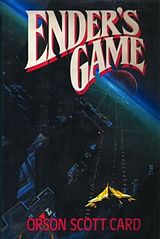
Writing on Reading: Ender's Game

We interrupt our work on the new issue to discuss a novel, Ender's Game (1985) by Orson Scott Card. I recently reread this to see if it's as good as I remember. It is. I may be biased in favor of speculative fiction but I think this is one of the best books ever published.


Very briefly, the story is: in the far future humans encounter an alien insect-like race and they go to war. On Earth, children are bred to be soldiers and officers in the war. One such child is Andrew "Ender" Wiggin and he is chosen to go to Command School. At Command School he undergoes extensive game-like training programs and ends up playing a significant role in the war while still a child.
Perhaps this sounds a bit mundane.
Why, then, is this book so amazing? The author does an excellent job plotting; there are some fabulous plot twists, particularly at the end of the book. The author also does an excellent job characterizing Ender, the smart misfit. Card really puts the reader inside Ender's head. We're right there as he's bullied, has to fight for his life, wins and loses games, etc. This is the very essence of fiction: making the reader understand what it's like to be someone else. Moreover, for many bullied or misfit kids it was comforting to know they weren't alone in their experiences.

This novel also deals with bigger questions. The kids behave the way kids really behave rather than how adults wished they behaved; this was eye-opening for some adult readers. It also makes one think about the whole concept of war and genocide. Is war ever justified? Is genocide? What if your whole world was at risk? Perhaps most significantly it addresses the issue of good and evil within each of us. The very best fiction addresses such big picture ideas.

As a geek, I also enjoyed the shout-outs to other works. In particular, the anonymous military leaders who discuss their plans at the beginning of the chapters is very reminiscent of the Second Foundationers in Isaac Asimov's Foundation trilogy. Alluding to previous works of fiction makes a novel richer.

The take-home messages are:

  • When reading, think about what you're reading. What works? What doesn't work?
  • When writing, think about what you're writing. What works? What doesn't work? How can you write really effective characterizations to put the reader in your character's head? Can you add fabulous plot twists? How can you address big picture ideas in your fiction? How can you allude to other fiction?

Good luck with your writing!

31 January 2012

our process

There seems to be a little confusion about our production process so I thought I'd remind you how we do things, in perhaps too much detail. :)
  1. You send us your fabulous stories.
  2. Our distribution editor randomly assigns stories to an editor.
  3. Said editor reads this "slush" and decides to reject or to hold for voting and sends you an email with this decision.
  4. When the submission period ends all the editors read and study all the hold for voting stories and rank them numerically.
  5. Our statistics editor combines these numerics from each editor into an overall story ranking for the issue.
  6. At the production meeting--in between drinking and eating and cussing and arm-wrestling--we discuss the stories and the overall issue ranking to decide on the stories we will publish. At the production meeting we do have to consider issue balance; we can't have 5 horror stories, for example. Additionally, we discuss and decide on the columns and art work and all other aspects of the issue. We also assign each to-be-published story to an editor.
  7. After the production meeting we email all the authors with the good or bad news. The acceptances also get a contract to sign and some other info. We ask them for a bio and paypal account info.
  8. After we get the contracts back from the authors we start editing the stories. After the editor edits the story we email the author with the changes and they agree or disagree, this may lead to a discussion. I think one time an author and an editor could not come to an agreement so we parted company, to our mutual satisfaction.
  9. The editors add each of the stories and columns to the webpage using our content management system. I like to ask the authors to check their stories after they've been posted, but before we go live (I'm not sure the other editors do this). We double-check everything.
  10. We go live!
  11. We celebrate and enjoy the issue. :)

It just so happens we do have a production meeting this week.

I noticed one of the stories in our hold-for-voting file has a problematic cover letter, namely, the author tells us what the story is. The problem is this: what the author says does not necessarily agree with my perception of the story. I'm not sure what will happen to this story at the meeting. :( Time will tell.

Generally, a simple cover letter is better. It should include the author's name and contact info, the story title, genre, and word count. It may include past publishing credentials. After that, you're starting to get into dangerous territory...

I'm getting excited about our next issue: February 28, 2012, how about you?

Stay tuned for more info!

24 January 2012

maximum impact

I recently had a short story critiqued in a writers' workshop. This was a good experience because it reminded me of some things I needed to be reminded of, namely, a short story should be as dramatic as possible. I'm a bit embarrassed to say my rough draft could have grabbed the reader more. It could have had a bigger impact.

In revisions I found maximum impact came from knowing my protagonist and making sure all aspects of my story were interconnected.

  • Every other character in the piece should have had a strong connection to the protagonist. For example, it's not enough to put a child in danger, the child should be related to the protagonist, if possible.
  • The setting should be important to the protagonist. It's not enough to put the protagonist in the setting. The setting should be crucial to the protagonist--this is the place he or she has to be.
  • External plot complications need to be unique to the protagonist. Think about the protag. Determine what's the worst possible thing that could happen to him/her--and then make it happen.
  • External plot needs to be linked to internal character arc. In our example, perhaps the protag him/herself was in peril as a child, so he/she cannot abide kids in peril. Would your protag sacrifice him/herself for said child? Ooh, now that's dramatic.

What do you think? Do you have any tips for achieving maximum impact in fiction?

Good luck with your writing!

17 January 2012

writers cheat sheet

I had the opportunity to critique some less experienced writers in workshop recently. Writers who have not partaken in many workshops tend to do many of the same not-recommended things. If you would like to appear to be an experienced workshopper, here's my cheat sheet for writers:
  • Dialogue Tags:
    • Know how to punctuate these, e.g. "You rock," Joe said.
    • Only use "said" or "asked" in your dialogue tags. I'm not kidding.
    • Only use one dialogue tag per paragraph.
    • It's better to use beats instead of dialogue tags, e.g. "You rock." Joe picked up his pick.
      (Beats are small physical actions.)

  • Characters' Physical Description:
    • Characters shouldn't think or talk about the color of their skin, hair, eyes, etc. when in their own point of view.
    • Generally, do not describe the height, weight, girth, color, of characters--unless you write romance, or maybe fantasy.
    • Describe characters via qualities that are important by showing these qualities to the reader.

  • Don't use Distancing words, like "thought", "perceived", "realized"--anything that's a synonym for "thought". These put an extra layer between the character and the reader and you don't need it. Similarly, words of perception like "saw", "heard", "felt" also put distance between the character and the reader.
  • Don't use extra words like "that", "well", "just", etc. These are rarely needed or effective.
  • Don't use adverbs.
  • Know your genre. Of course Electric Spec writers know they write horror, science fiction, and/or fantasy--so you're ahead of the game. Kudos!

We are starting the production process for our February 28, 2012 issue so stay tuned for more information.

Keep submitting (for our May 2012 issue)! Thanks!

10 January 2012

Submit

No doubt some of you marvelous writers out there are wondering 'Why should I submit to Electric Spec when I can just e-publish my work myself?' Well, I'll tell you:
  • For one thing, Electric Spec is a great little ezine with a very good reputation and plenty of hits (yes, we're talking many thousands). Authors in our issues don't have to worry about self-promotion; promotion is all taken care of.
  • Readers love free stories. Readers will read and enjoy your stories, and that can lead to name recognition the next time you submit a story or novel somewhere. And you can post the story link on your homepage, email it to your parents, etc. :)
  • We do significant editing. For almost all our stories, we edit. This usually consists of cleaning up minor spelling and grammar issues and shortening the work. For whatever reason, authors rarely start the story when it starts--if you get my meaning. Often stories also include extraneous bits which we get rid of. One of us editors even has the nickname The Slasher--it's not me.
  • Insert-your-reason-here. I'm sure there are some other good reasons to submit to Electric Spec. Feel free to mention them in the comments. :)

I know it's hard to believe, but the submission deadline for the first issue of 2012, February 28, is fast approaching. Said deadline will be midnight January 15, 2012. So, get your stories in if you want to be considered for the next issue.

Good luck and thanks for submitting!

03 January 2012

plot twists

Here's another insight I've gleaned from slush: in short speculative fiction, twists are good. Here at Electric Spec we seem to publish stories with plot twists somewhat frequently. For example, "The Little Voice" by Neil James Hudson in our most recent issue has a nice twist near the end. (Check it out if you haven't already.) The reason this works, however, is the author set up the plot twist from the beginning. When the twist is revealed it makes the reader re-evaluate all the events of the story, see them in another light. Ah. Our perceptions shift. Things become clearer. Ideally, the author does this without lying to the reader.

Perhaps the most famous (to this crowd!) example of a plot twist would be from Star Wars Episode V: The Empire Strikes Back when Darth Vader tells Luke: "I am your father." However, I maintain this wasn't done in the ideal manner; the creator lied to the audience, i.e. prior to this scene, Obi-Wan and Luke's aunt and uncle have all told Luke his father is dead.

Why are twists good? Plot twists are good because we all (including editors!) want to read something fresh. We're tired of the same old, same old. As the fabulous Robert Silverberg said, ...the basis of all the successful and lasting narrative of the past five thousand years ...[is] A sympathetic and engaging character (or an unsympathetic one who is engaging nevertheless), faced with some immensely difficult problem that it is necessary for him to solve, makes a series of attempts to overcome that problem, frequently encountering challenging sub-problems and undergoing considerable hardship and anguish, and eventually, at the darkest moment of all, calls on some insight that was not accessible to him at the beginning of the story and either succeeds in his efforts or fails in a dramatically interesting and revelatory way, thereby arriving at new knowledge of some significant kind.

Bring on the twists!

21 December 2011

Interview

Chiseled in Rock is re-running an interview with me today.  It's mostly about editing.

I hope everyone is enjoying the holidays!

20 December 2011

more slush notes

At the risk of being discouraging, I've got some more notes from the slush pile to pass along...
  • Be careful with physical descriptions. The current modern style in short speculative fiction is NOT to give readers the physical hair, eye, skin color, height, weight, etc. of your characters. When I read "Joe was six feet, two inches tall, with red hair and blue eyes." this sets off an alarm bell. Among other things, I'm worried that the writer doesn't read short speculative fiction. It's difficult to be a good writer if you're not a reader. The point with description is: the author needs to convey only the important things about the character.
  • Be as specific as possible. A lot of descriptive words can be very vague; try to avoid them. For example, "He was handsome." tells this editor virtually nothing. What I think is handsome will be different from what you think is handsome. Let the reader and editor know specifically what the character thinks is handsome. :)
  • Be careful with subject matter. I'm going to go out on a (teeny-tiny) limb and say: vampires and werewolves are a tough sell. You have a much better chance at being bought by coming up with something fresh.
  • Be careful with your cover letter. I've been reading some cover letters that set off alarms:
    • Don't tell the editor how great, awesome, fabulous your story is.
    • Don't explain what happens in your story. If I can't tell from the words on the page in the story you are in trouble anyway.


    Cover letters should include your name, pen name if applicable, contact information, past publications, other professional information.
  • Know your genre and watch out for flying snowmen. Current SFWA President John Scalzi has a fun post over at AMC filmcritic.com: The Flying Snowman in Science Fiction Films like "Star Trek". Scalzi discusses implausible elements or events in science fiction or fantasy works that throw you out of the story. Authors: don't do this.
Despite my comments, thank you for sending in your stories. We appreciate it! Good luck!

13 December 2011

lessons from slush

We are starting to get through the stories you all have been kind enough to submit for our consideration for the next issue. (Thanks, by the way!) My recent readings have prompted me to pass along some advice...
  • Make sure your story makes sense. All of us writers have trouble sometimes putting our visions on the page. It's crucial that you have a critique group or a beta reader or someone you can ask: "Okay, what happened in this story?" If they can't answer you, you have a problem.
  • Consider writing more than 1000 words. It is extremely difficult to write a compelling story in less than 1000 words. Remember a protagonist has to have a problem, attempt to fix it, and the reader should care what happens.
  • Avoid greetings and goodbyes. Generally, "Hi." and "Goodbye." and similar bog a story down. In reality, of course, we do say these things, but this is an example of how fiction is better than reality: there shouldn't be any mundane stuff. Everything needs to serve the story.
  • Write a good opening. Generally, excellent stories have some intriguing narrative to start off. Out of curiousity, I took a look at some of our stories in the current Electric Spec issue:
    • I knew I could never bring up Kylie properly.
    • A foot-high pile of bills on a table wasn't the largest amount of money I'd seen in one place.
    • Tommy is a little on the boring side.
    • If I've learned one thing in the two years I've been trapped in here, it's this.

    As a reader, I'm intrigued and want to learn more. Don't you? (Of course, you all have already read all these stories, right? :) )

Please keep sending us your stories, and, good luck!

06 December 2011

genre accessibility?

Over at Locus Online, there's been an interesting Roundtable on Genre Accessibility, which asks if contemporary science fiction has the capacity to cross over to a mass audience. I disagree with the implicit premise here which seems to be contemporary speculative fiction is not appealing to a mass audience. Have these people been to a bookstore, the movies, or turned on the TV lately? Have they ever heard of Harry Potter or the Twilight series or the Hunger Games trilogy? Or George R.R. Martin's A Song of Ice and Fire or Charlaine Harris' Sookie Stackhouse/True Blood series? I could go on and on. Of course, some of you might argue my examples are more fantasy than SF, and this is mostly true, but I could also name SF recent hits, like Cormack McCarthy's The Road. As I said, it's an interesting article; check it out.

Some speculative fiction that is very accessible can be found in our recent issue of Electric Spec. For example,


Check them out, too! :)

30 November 2011

New Science


I found this map of the future explorations of science fascinating. The Institute for the Future just had their conference and created a map from their discussions:

The map focuses on six big stories of science that will play out over the next decade: Decrypting the Brain, Hacking Space, Massively Multiplayer Data, Sea the Future, Strange Matter, and Engineered Evolution. Those stories are emerging from a new ecology of science shifting toward openness, collaboration, reuse, and increased citizen engagement in scientific research.

From this I envision all science turning into a giant wiki, even more than it is now. We can power and fund more study than ever before, harnessing the Internet and the Information Era. (Though I would argue we're entering a new era quickly: The Exchange Era.)

And of course for writers, the ideas based in these new scientific explorations are boundless. Have fun with them!

29 November 2011

New Issue Tomorrow!

It's down to the wire... A brand-new exciting issue of Electric Spec is coming November 30, 2011!
We have five fabulous stories from authors Neil James Hudson, Sam Kepfield, Sharon Dodge, Simon Kewin, and Steven Young.
We have an intriguing interview with up-and-coming novelist Rob Ziegler.
And our film critic takes a look at the work of Pedro Almodovar.
Of course, we also have a piece of excellent cover art, this time by Cathy Miller Burgoyne.
Be sure to read the new issue tomorrow!

Interestingly, two of our authors are 'repeat offenders.' To tide you over until tomorrow, check out Sam Kepfield's earlier story with us "Salvage Sputnik" and/or Simon Kewin's "Remembrance Day".

22 November 2011

carol berg interview

One of our favorite authors, Carol Berg, has a new interview over at sffworld.com: Interview with Carol Berg. Go check it out to learn more about why she writes fantasy, enjoys torturing men, er, male characters, and more. :)

Of course, back in 2007, our own David E. Hughes did an excellent interview of Ms. Berg: Interview with Multiple-Award-Winning Author Carol Berg. Amongst lots of other neat information, Berg gives advice for up-and-coming writers:
  1. Read, read, read, Read good writing. Read across genres.
  2. Write, write, write. Revise, then write more. Find serious fellow readers/writers with whom to exchange critiques. Learn to give critique and learn to take it.
  3. Learn the craft of writing. Learn grammar, learn the cliches of your chosen genre and how to avoid them (this is particularly important for fantasy writers where cliches are rampant thanks to the heavy influence of Tolkien imitators and D&D-like role-playing games!). Learn about maid-and-butler dialog, said-bookisms, and using your opening to make a contract with the reader, always remembering that craft does not diminish art.

Thanks, Carol! (And Dave!)

Coming November 30, 2011 a New Issue of Electric Spec! Yes, folks, it's true; it's just a little over a week away...

15 November 2011

why write?

We owe you guys a post, so here goes. Behind the scenes, we continue to labor on the upcoming excellent November 30, 2011 Issue of Electric Spec. Mostly we're editing stories right now. Everything's coming along well. We are excited to share the issue with you at the end of the month.

But somewhere in there I got to wondering, why do people write stories? George Orwell in his famous essay "Why I Write" gave multiple reasons:

  1. Sheer egoism.
  2. Aesthetic enthusiasm.
  3. Historical impulse.
  4. Political purpose.

Obviously, we're not all Orwell. :)
I've often heard authors say "I write because I can't not write." Being a writer is really the only vocation one can toil at for years with little or no financial compensation. I guess that makes it an avocation! Why do I write? I'm still pondering that one...

How about you? Why do you write?

10 November 2011

Electric Spec update

Greetings, dear readers! We, the Editors, successfully completed our production meeting for the fabulous new November 30 2011 Electric Spec Issue. There was lots of food and drink (beer!) consumed and imbibed. Spirited discussions ensued...but no one got bloody. Huzzah! One of us even had a chocolate volcano (okay, it was me). The point is, we did select five very good stories for our next issue. I believe all authors have been emailed one way or the other. Thanks for submitting; we appreciate it.
We discussed cover art and the upcoming movie column and an interview column. Everything's coming along nicely. Please check it out November 30 2011.

What's left to do? We have to edit the stories and columns and input the content into our content management system. And, of course, get the final go-ahead from authors.

We also need to start working on slush for our next issue.

As an aside, for any writers out there, we didn't have a lot of straight fantasy in submissions this time. We had some horror/fantasy, but no epic or high fantasy and not much urban fantasy. Recall epic/high fantasy is fantasy set in a so-called secondary (imaginary!) world. In contrast, urban fantasy tends to be set in the primary or real world with some magical or other paranormal elements thrown in. Some people call this type of primary world fantasy "low fantasy."

Anyway, we do like to have a variety of speculative fiction so consider sending us some fantasy for our next issue. :) Thanks!

08 November 2011

post thursday

Hi, folks. This is just a quick post to tell you we'll post on Thursday Nov 10 with some more behind the scenes Electric Spec info.


Good luck to everyone participating in NaNoWriMo!
Hang in there. :)

01 November 2011

behind the scenes report

Greetings, ElectricSpec writers and readers! We trust you survived Halloween okay, and hope those slammed by that freaky snow storm on the east coast are keeping warm. Here at Electric Spec we are between snow storms and working on the upcoming November 30, 2011 issue. We have gotten through the pre-October 16 slush--so you should have heard from us if you submitted a story before then. We've scheduled our production meeting, aka the beer-swilling arm-wrestling, knock-down drag-out, driven to fisticuffs debate over which stories to pick. We're working on cover art and columns and all the other behind-the-scenes stuff we have to do.

We will make our decisions about stories by the end of next week, so hold-for-voting folks should hear from us by then. Everything is looking really good at this point. Phew! I think that about covers everything regarding behind the scenes reportage. Be sure to check out the fabulous new issue on November 30, 2011!

Oh, and good luck to the NaNoWriMo folks!

Thanks for reading. :)