We have already been working hard behind the scenes on the slush pile. There are lots of nice stories. We should have another great issue in February 2022.
If you're submitting: good luck!

We have already been working hard behind the scenes on the slush pile. There are lots of nice stories. We should have another great issue in February 2022.
If you're submitting: good luck!
I originally wrote "The Most Wonderful Time" as a spoken-word piece.
Here in Minneapolis there is an open mic event called Not-So-Silent Planet, which is a science fiction, fantasy, horror open mic. Typically the monthly event is themed, and the theme that month was "Holidays". I knew there would be plenty of holiday horror stories (and I was not wrong), and I really wanted to write a space opera story. I felt like you don't see holidays depicted in science fiction and wanted to write a fun piece.
The monthly show also included a challenge line to be integrated; "That's when Uncle Jeff chimed in." This was great fun because a few years back a friend of my brother-in-law - named Jeff - got into an argument with my wife at Christmas and he said to me, "You need to control your woman." at which point my wife stood up and sent him scrambling to get away. It was too good not to add.
I'm pleased to present you with "The Most Wonderful Time," one of the funnest stories I've written.
Very interesting! Thanks a lot, Michael!
Be sure to check out all the stories in the November 2021 issue!
We need to thank our excellent cover artist and authors. Hurray for our creatives!
We need to thank our excellent editors and tech staff. Thank you for all your hard work!
And most of all, we need to thank our readers! Woo hoo! We wouldn't exist without you!
Thank you, everyone!
We're taking a couple days off for the holiday...
Coming next week, November 30, 2021, a new issue of Electric Spec!
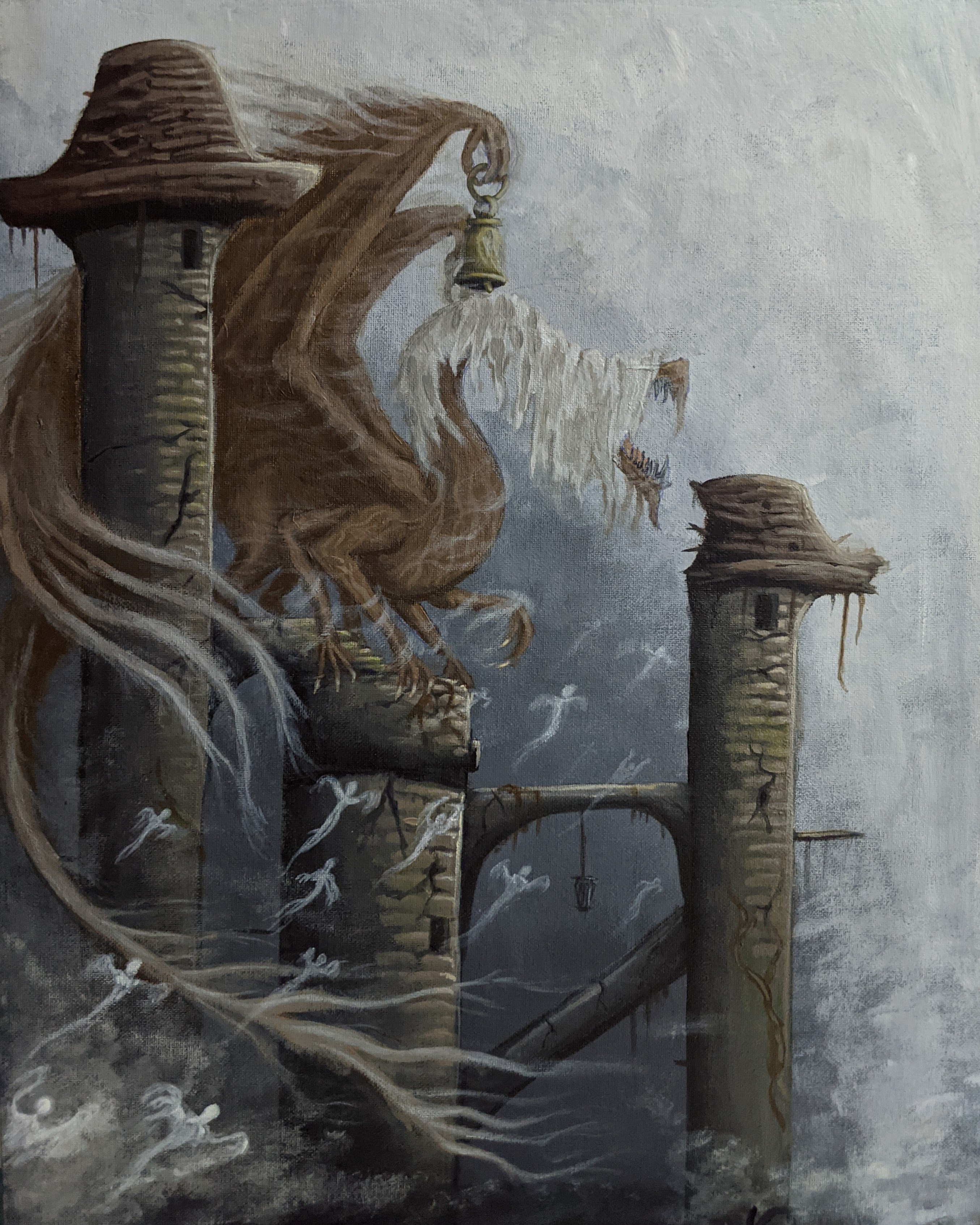
Neat! Check out his bio on our Artists page. Check the whole issue on November 30, 2021!
Thus, all authors who submitted for the notable November 2021 issue should have heard back from us by now. Authors of accepted stories should have received an initial email from your editor, including a contract. Please send back the contract ASAP, so we can start working on your story! Yes, we are excited! I hope accepted authors will also take us up on the offer to blog--stay tuned for that, as well.
I did hear back from some authors already and very much appreciate their alacrity and enthusiasm! Woo hoo! Thank you, authors.
If you submitted a story, but it wasn't accepted: Thank you, author! We appreciate you, as well!
Starting next week, I'll start previewing the new issue here. Should be fun!
What's next? All the editors are carefully considering the finalist stories and ranking them in order of preference. We have our production meeting coming up this weekend. No doubt, this will be a contentious knock-down, drag-out fight! Or not. :)
I'll let you know, next week.
It was called "Writing Short: Focus on Short Stories."
There are many excellent reasons to write short fiction. Short stories are a great way to hone your craft. Short stories are a great way to get your name out there and get new readers. Short fiction is great for giveaways on your website or newsletter or for deals/ads. Short storeis are a great way to make some money--or not.
The craft section included discussions of characterization, plot, setting, emotion, theme, symbols, voice, mood, and style. The middle section was about marketing. A short story is a marketing asset. The final section was about different fiction publishers and rewards that aren't necessarily cash.
The bottom line is: short stories are valuable on many levels.
Good luck writing short!
Savvy writers know we closed to submissions for the notable November 2021 issue of Electric Spec! But don't worry; we're accepting subs for the February 2022 issue. Get those stories in!
For those who did get their stories in, we are hard at work behind the scenes...
I'll tell you more next week.
Over the last couple of years we have received more and more flash fiction.
What is flash fiction? Savvy writers know it is a short short story. Definitions vary, but in general, it's a story of less than 1000 words.
There are actually a lot of different terms for this including dribble, mini-saga, micro-fiction, drabble, micro-story, sudden fiction and others. It doesn't matter what you call it.
It's important to note that even though the story is short, it still needs all the elments of a short story including character, plot, emotion, and setting.
The most famous flash fiction, a six-word story, is attributed to Ernest Hemingway: For sale: baby shoes. Never worn.
There is no doubt this is a story with a lot of emotion because the reader brings a lot to it...
However, flash fiction is more difficult than standard short fiction. It's challenging to get all the story elements into so few words. At Electric Spec we have rarely published flash fiction because of this.
But, if you care to accept the challenge, go ahead and flash!
Good luck!
As editors, we sincerely appreciate you sending us your stories. We also appreciate you following the rest of the rules we've set up, based on years of experience:
This means we have started working on the new issue; specifically, we are going through the stories in slush. (Thank you for sending us your story!) Hopefully, if you're submitting to us, you read this blog at least occasionally. One of the things I've said is market is important. Luckily, it's easy to get a handle on this market. You can read previous issues of Electric Spec for free. Woo hoo!
Thus, for this market, we like some showing. I've read quite a few stories in slush lately that have little, or no, showing. Rather than exclusively telling me the story, show me the story! This means show the dialogue, thoughts, feelings, and action in the moment. Do not narrate everything for the reader. If I read a story that is exclusively narration, telling, with no showing, I will likely reject the story.
Good luck with your story!
The urban city setting for “Phantom Limb” could probably be any large city a few years hence, but it was actually inspired by London. At the time the story was written, I was working in central London and the streets, park and metro mentioned were all traced out (in my head, at least) based on real places. (The Soho Square area, to be exact). I’m pretty sure at some point on a lunchtime walk, the well-known Boomtown Rats song “I Don’t Like Mondays” must have been playing on my iPod and then I basically had all the ingredients I needed for the story.
The first draft was written on the morning commuter train into London. It amused me greatly that while my fellow passengers sat reading somber newspaper stories about declining share prices and the latest crisis being mishandled by the government, I was bringing havoc and mayhem to London’s streets. For a time I worried about fellow passengers shoulder-surfing my stories and wondering about the sanity of their fellow passenger, but if anyone ever noticed, it was never reported to the authorities.
Interestingly, in my many lunchtime walks around the area, I realized that area truly is the hub for post-production and video-graphics companies. I counted a dozen or so (including big name companies) all within a few blocks) and so somewhere along the way bits of the story started to fall into place. However, there are no surveillance drones patrolling London streets (yet) and I’m pretty sure the Metropolitan Police aren’t using the tactics described in the story.
For the record, I would also like to state that any chips that may have been inserted in my own head during this time were purely of the carbohydrate variety.
This story is a retelling of the old Norwegian fairytale “East of the Sun, West of the Moon,” which my dad read to me several times as a bedtime story in early childhood—early enough that I only half-remembered it as an adult (“what was that story again? The one with the bear and the girl?”). I rediscovered it in 2020 after some Wikipedia sleuthing. I was going through a phase of obsession with myth/fairytale retellings at the time, and decided to develop a modern take on this cozy, folkloric Scandinavian odyssey.
My project started out nice, but grew more and more pagan and American Gods-ish the more I wrote. Before I knew it, I was researching old Saami animist beliefs and shamanism, and had somehow rewritten my favorite childhood fairytale to center around a sketchy human sacrifice.
This was also one of the first times I’d run a story through the Critters critique workshop’s gauntlet, a very humbling experience that connected me with about 20 different reader/reviewers who didn’t pull punches. Rewriting my already-bizarre story afterwards turned out to be one of the trickiest writing exercises I’ve tried this year.
A huge thank-you to Electric Spec for selecting my work! It’s an honor to be featured here.
We need to thank our excellent cover artist and authors. Hurray for our creatives!
We need to thank our excellent editors and tech staff. Thank you for all your hard work!
And most of all, we need to thank our readers! Woo hoo! We wouldn't exist without you!
Thank you, everyone!
I'd like to give a nod to the late, great Robert Heinlein for the inspiration for my portrayal of Riley, the protagonist of my story "A Thousand Ways."
When I was a kid in the middle of the last century, my mom often dropped me off at the town library after school. At the time I assumed she just wanted me out from underfoot, worried as she always was about performing her household duties up to that era’s oppressive standards.
Later I understood that she was also sharing a gift with me: her love of reading. (She hid her own library books under the toaster cover, as Dad considered her reading for pleasure "wasting time").
During those long afternoons I roamed the dusty stacks, pulling out any volume that looked interesting. With no adult guidance (thank goodness), I didn't know there were rigid sets of girls' books and boys' books. And so I fell across Heinlein's Juvenile Novels--what we would now label as YA.
That was it for me: I knew I was meant to read, and write, speculative literature.
It's true that Robert H. could only envision boys as main characters in his adventures. And at least one of his books was serialized in Boys' Life, a Boy Scout publication, effectively bypassing young female readers. (I like to picture some of those boys' sisters innocently saying, "What magazine?", then following a Heinlein adventure under the covers with a flashlight.) But his books still spoke to my inner girl nerd, an entity that had scant reinforcement in that time and that place.
One of my favorites was Farmer in the Sky. In this book, a family emigrates from a dying earth to the Jovian moon Ganymede, which they have been told is a fertile farm colony. I vividly remember the immediacy and verisimilitude of teen-aged Bill's new environment. In spite of the fact that little was known about this moon--which just gave Heinlein's prodigious imagination more leeway--I was right there on Ganymede with Bill.
When I set out to write "A Thousand Ways," Riley was very clear with me about how to tell her story. I had to make people not just see, but feel what a first-generation Martian kid would feel. How the challenges of adolescence--sibling rivalry, an unrequited crush, an existential threat to her community--would play out just as it would for an Earth kid. But, although one-third g, dust storms, and a cramped underground habitat would be an alien environment for us, to Riley, it's simply home.
No matter what planetary body it's on, there's no place like it.
My thanks to the Electric Spec editorial team for giving Riley her voice. It's great to join this talented group of authors and editors.
"Shaytandokht" is one of the most difficult stories I've ever written, but it's also one of my favorites.
The story is set in the frozen desert of modern Afghanistan, and the title refers to the Farsi name of a woman named Shaytandokht (pronounced "set-on-doh-hut"), who a few locals say is the daughter of the devil.
The story consists almost entirely of three men walking across the desert, just talking. But what made the piece so difficult to write is that two of the three men don't speak the same language and rely on the third man to translate between them. And none of them are named, so ensuring the reader knows who is talking means leaning heavily on each man's individual mannerisms.
Doing that became complicated by the fact that I wanted the piece to have the feel of an allegory, so I used very sparse and simplistic phrasing throughout.
I outline my stories in great detail before I write, so the first draft of "Shaytandokht" took only a few hours, but the revision took days because so much depended on the individual word choices. The rhythm of the language had to reflect the stilted nature of the three men's somewhat adversarial relationships, so I was constantly replacing words that either felt too expressive for the trio or (for lack of a better word) civil.
One of the trickiest aspects was illustrating the men's individual personalities. For instance, when the non-English-speaking man relayed something, he would display certain mannerisms relating to what he said. But the guide, who would normally just translate the first man's words into English, would sometimes have his own reactions to the man's words, so every aspect of the ongoing conversation would be colored by the guide's own word choices. It became extremely difficult to create that constant juxtaposition of the original words and the speaker's mannerisms, and the guide's translation and his reactionary mannerisms. Hopefully, the reader will never notice any of that, but trying to make it transparent took more time than the entire initial draft took to write.
Probably because of all the effort to hide the complexity, "Shaytandokht" is one of my densest pieces. At 2,100 words, it's quite short, but I think it packs more punch per word than anything else I've written, and even though we barely get to know the characters in that short time, I secretly like them all.
I do hope you enjoy "Shaytandokht" as much as I enjoyed writing it.

I don’t write about siblings. That probably sounds deeply ironic, coming from the author of a story called “The Promises of Sisters,” but it’s true. Like many fantasy authors, I end up with a lot of orphans and only children. It’s hard to go on magical adventures when your sibling wants to come, too.
I do, however, have two sisters. I’m the oldest of three, and my sisters have profoundly shaped me as a person. They regularly challenge and infuriate me, and they support me even when I can’t support myself. Such is the power of siblings. They also read my writing regularly, although hilariously, they won’t read this story until it comes out (hi Emily and Aly!).
When I began writing "The Promises of Sisters," the working title was "What It Means to Burn," and it was merely about a young woman who went to the land of the dead and then returned. But you can’t send someone to the land of the dead without a good reason, and I was struggling to find that reason for my protagonist.
It can be a hard thing, as a writer, to have an idea for a story and have that story take you in a completely different direction. So it was with this tale. While I was trying to walk the land of the dead, my protagonist was trying to get to her sister, and she wouldn’t rest until I’d added that sister into the story. As usual, the writing knew better what it needed than I did myself. The sister stayed, and the story unfurled from there.
When it came time to write the ending, though, I was challenged yet again. I don’t want to give anything away here, but I will simply say that sisterhood works both ways. I’m sure I infuriated my siblings just as much as they did me, and I know they love me as much as I love them. Love is not a straightforward road, and sisters will be pulling each other’s hair one minute and walking the paths of the dead for each other the next. Metaphorically, at very least.
Thus, all authors have, or will soon, hear from us regarding the disposition of submitted stories. 'Yes' authors should have, or will soon, receive a contract. As soon as we get those back, we start editing stories. Some editors think this is the funnest part of being an editor--helping make stories even better.
Our tech team has already starting creating the issue on the website. We are looking forward to getting blog entries from authors/artists for this very blog.
So, stay tuned for more Electric Spec info right here!
We are working hard on the Awesome August 2021 issue of Electric Spec.
Next week I'll report on the Production Meeting!
I better get back to work...
Bonnie Ramthun is a Colorado mom, wife, and novelist. Her novels for adults include the detective Eileen Reed mystery series of Ground Zero, Earthquake Games, and The Thirteenth Skull. Her middle grade mystery series includes The White Gates, Roscoe, and Haunted Waters. The White Gates, published by Random House, was a Junior Library Guild Premiere selection and a finalist for the Missouri Truman Award. She is a former chapter president of Mystery Writers of America, a member of Rocky Mountain Fiction Writers, and a former war gamer for the Department of Defense.
Welcome, Bonnie!
Here's some miscellaneous feedback for authors:
Don't include gratuitious sex and/or violence. We especially don't like child rape or murder. Rape or murder of anyone is a tough sell, to be frank. Killing off characters in a short story and having the reader care is difficult. Often, there isn't enough page space to make the reader feel empathy for the victim.
That's why we prefer spooky or eerie macabre fiction rather than gory horror.
Don't offend the editors. This means, in your story, you shouldn't blatantly insult editors. Or authors. Or, anyone, for that matter. This idea holds for the cover letter as well.
Closely related to this is: don't include extreme politics or conspiracy theories in your story. I'm sorry to say, we had a story recently that included denial of the Holocaust as a major story element. Hard pass--exceptionally hard pass. In fact, we asked that author not to send us any more stories.
To end on a positive note: Do send us the story only you could write. We love personal, unique tales. What are you expert in? Passionate about? Who or what do you love? Write us a story about it!
Good luck!
We have started working on the new issue, in particular, on stories in the slush pile. We periodically get requests for story feedback from editors. Sorry! We can't do that except... right here! So here you go:
We'll probably include more tips right here next week.
Good luck with your writing!
They say: Electric Spec is a speculative fiction magazine that is published four times per year and they will consider any story between 250 and 7,000 words with speculative fiction elements. They prefer science fiction, fantasy and the macabre, and pay $20 for every story they publish. Although they don’t acknowledge story receipt, they aim to respond within 135 days by email, with a “reject”, “accept”, or “hold-for-voting” message. If you haven’t received any message by that time, please resubmit. Take a look at their submission guidelines here. Read the current and previous issues here.
I didn't include their links.
I must admit I don't know much about this site, but it's nice to be mentioned. If you do know about it, feel free to comment. ;)
Electric Spec is currently accepting submissions!
Woo hoo!
Check it out!
Thank you so much to all the authors! To the cover artist! To the Electric Spec team! It's an honor to work with so many great creatives. Woo hoo!
And, of course, the reason we're all here: Thank you Readers!
Here's a fun thing to do -- find out how the brains of your friends work. I promise that interesting conversations will result.
Start by telling a friend that you're going to say a few sentences and that you'll ask afterward about what you just said. Then say something like this, "You see a person walking beside the street. Someone going in the other direction passes with a dog, and a car drives by." It doesn't much matter what you say. Just be sure to leave out the details, and only offer a few simple sentences about a scene. Then ask your friend to tell you what you just said.
Some people will add texture to the recollection. Some will stick to what you said. Others may only be able to recall one sentence. Regardless, when that's done, ask your friend if the thing they just recalled was something they saw or something they heard or something else entirely. The point is to get to how they formed and retained the memory.
In doing this little brain glimpse exercise with one of my favorite writer friends, I learned that she created the memory of what I said completely in sound. She had no visual at all. It turns out that when she writes, she doesn't see anything either. I was stunned at the time, but my conversation with her was an early one. I've since learned that the way memory works is all over the place.
I have about six mental tracks going at once with four of them completely visual. In my field of view when my eyes are open, the layers I can see exist on top of each other. One of the non-visual mental tracks sometimes ponders what it would be like not to have so many tracks observing and thinking about things all the time. The irony isn't lost on me.
In my visual way, I wrote "The Kipnibbles Singularity." I started with the name Vespasian. The image of a cat immediately came to mind, and I started to look around in my brain for what was in Vespasian's environment and what was important to him. The house revealed itself to me from the ground up. I saw that Vespasian had very strong feelings toward his food bowl, and that bowl was special in a science fiction way.
That story was a lot of fun to write. My mental tracks don't spend much time visualizing a technological singularity, but when they do, Vespasian the Cat is always involved.
Very interesting! Thanks, Andrea! Check out all the stories on May 31, 2021!
Sleep can telescope or collapse time, and can mess with our perceptions. Yet because it's something that we (usually) do every day, we regard it as mundane.
Sometimes we're not even aware that we are sleeping. How often have you seen someone asleep on a sofa, snoring, only to have them open their eyes and deny that they've been asleep? Sometimes, lying awake at night, I feel as if I haven't slept at all - but am aware that the time has passed too quickly for that to be true. I might have memories of things that happened during the night which, when considered in the literal light of day, are too fantastical to have actually happened. Conversely, sometimes people will tell me things I said or did which I don't remember at all.
Years ago, I woke up in the middle of an argument; I was furious that a friend refused to accept what I was saying. As I repeated my point over and over, my conviction faded until I realised that I was talking absolute rubbish. By the time I was properly with it, I couldn't even remember what it was I'd been trying to say. The friend, by the way, was genuinely present, and was somewhere between amused and baffled by their end of the conversation - apparently I'd appeared completely alert the entire time, forming sentences that were syntactically correct, but utterly meaningless.
I am a sound sleeper, and often my alarm clock intrudes into a reality which waking-me wouldn't recognise. The things I believe about this little, ringing monster beside my bed - and the decisions I can take while wrestling with it - often owe far more to dream logic that sense. I am, quite literally, not myself when only half awake.
Sleep is, by any definition, a mind-altering substance, and I wanted to write a story which explored the experience of living more permanently in that half-space between sleeping and waking.
Very interesting! Thanks, Elizabeth! Check out all the stories on May 31, 2021!
Why non-human protagonists?
That is the question I often ask my imagination, and always with a tone of accusation. After all, it’s much more difficult to write non-human protagonists. Whenever I do, I have to work that much harder to help the reader relate to them.
So what makes Guillaume the Gargoyle like us? What makes his story worth our time? A few things. First, he has an insatiable desire for novelty. I once read an essay about early human sex differences. It talked about the male tendency to push out into the unknown even in times of relative peace and comfort. That's weird, isn't it? And while it's not exclusive to males, it does speak to a certain impulse that makes our species unique.
Second, he's selfish, but in a particular way. He has an idea of what he wants and he makes the deadly mistake of assuming others want the same. Worse, he acts on it. If Guillaume wanted to hurt others, especially Benoit, then he'd be a flat, boring villain. Instead, his fundamental goodness becomes corrupted by a subtle and devious Ego. Sound familiar?
Third, and finally, he’s trapped in the Cycle of Trauma. Tauri the Stoneweaver created the Stonekin to suit his own needs. Guillaume created Benoit to suit his. Is Guillaume not perpetuating the same harm as before? He is, at first. He only escapes the cycle by sacrificing his own happiness for the autonomy of his new friend. Of course, that very decision earns him a second chance.
And if a weatherbeaten gargoyle can find his redemption, can't we all?
Very intersting! Thanks, Sean! Check out all the stories on May 31, 2021!
Not every pandemic story is about a virus. Last year, many people tried their hand at online dating, some for the first time. Other people tried to take advantage of them. Those stories inspired "The Annie Scam."
Fun! Thanks, Luke! Check out all the stories on May 31, 2021!
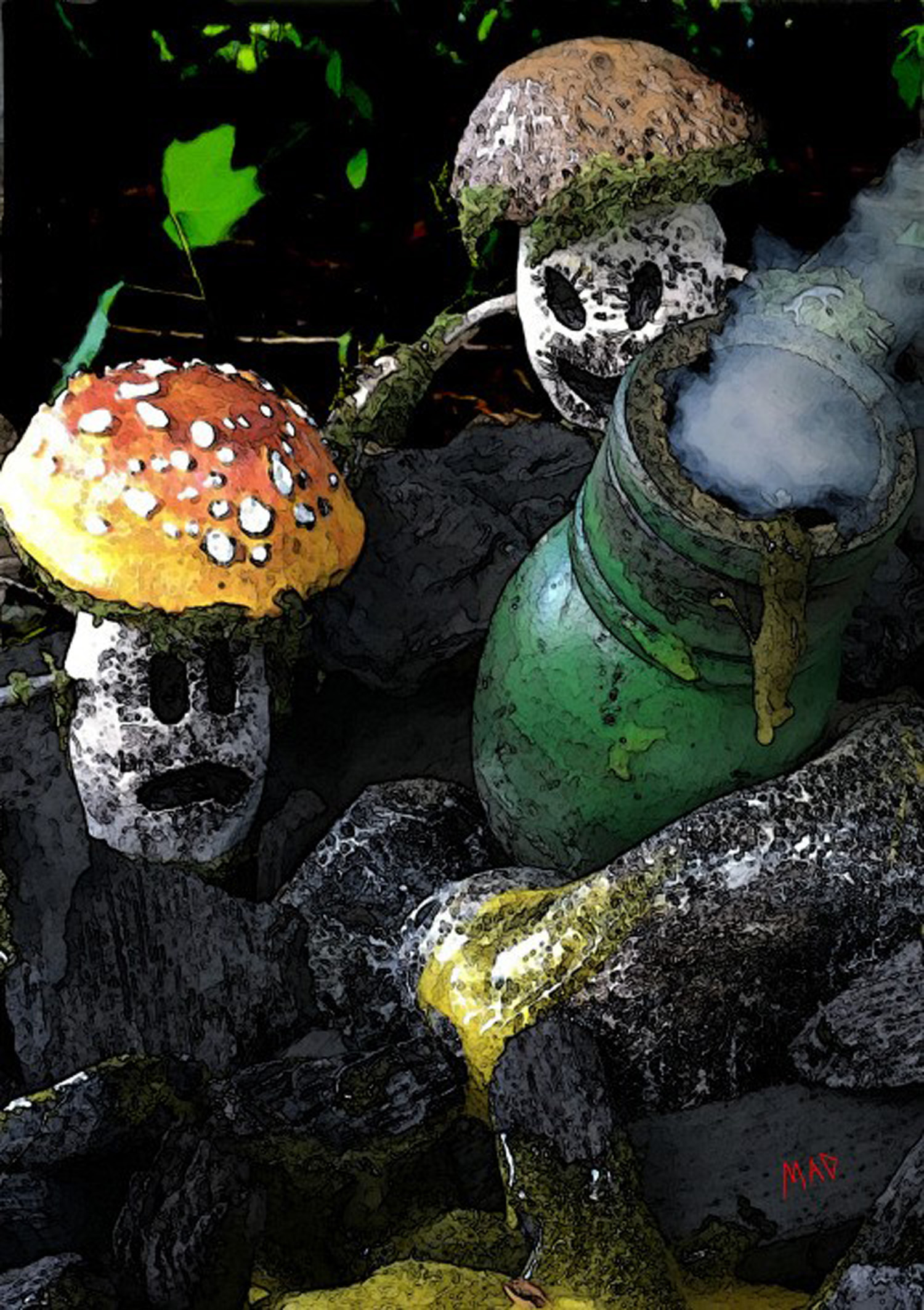
About the piece, he says: My mushrooms need goopy yellow plutonium juice to thrive. They need to eat, right? We must continue to provide for them. Quinuclidinyl benzilate does wonders for their spore production And dimethylheptylpyran--such an aphrodisiac!
Fun! Thanks for sharing, Michael! Check out his bio on our Artists page. Check the whole issue on May 31, 2021!
Down to business... All authors should have received an email from us with a yea or nay by now or within the next couple of days. If you haven't heard from us: please resubmit. Mysteriously, it does seem like cyberspace eats a story every once in a while. :(
Savvy readers of this blog know 'yea' emails are accompanied by a contract. Please send those back ASAP so we can start editing your story. Don't worry! We edit with authors.
All this means we should start posting blog entries from contributors in this exact space very soon. Woo hoo! Stay tuned!
May the Fourth Be With You!
Bottom line: next week I'll give the Production Meeting report here.
Thank you very much for submitting your stories! We really appreciate it!
How do you get your story published? You write the story only you can write. This means we want to see unique specific details of setting, world(s), characters, thoughts, feelings, and the like.
What are you passionate about? Why? Show us! What do you have expertise on? Why? Show us! What experiences have you had? What people have you known? What are your values and ideals? What are your dreams? What are your worries and fears?
When you incorporate your specifics, your story will shine!
Good luck!
This means your first page needs to be very good, and your first paragraph needs to be very good. Grab the attention of the editors with something unique. This could be beautiful prose, a dramatic problem, a personable voice, or a fascinating world. This could be a speculative fiction genre we don't get often such as steampunk, or humorous horror. This could also be a fun mash-up of speculative genres.
Often authors waste precious real-estate on the first page with backstory, setting descriptions or world-building info-dumps. Another way of putting this: often authors start the story too early. Start your story when the story starts.
If you must include backstory, descriptions, info-dumps, etc. put them a little later. (Notice this is market-dependent; some markets like front-loaded description.)
I hate to be negative, but ... If you have weird formatting, grammar issues or other similar problems on your first page, it will count against you.
Good luck making your first page awesome!
Today, I thought I'd pass along some tips regarding not annoying your editors.
Good luck!
I must admit some real-world events have overtaken us, or at least, me. I live less than a mile from a recent mass-shooting in the U.S. The rest of the editors live in the same general area. Consequently, I have no stomach for stories full of dead bodies. If you have such a story, please wait to submit it. If you've already submitted such a story: sorry, try another market.
We will all get through these challenging times with time and kindness.
Take care!
I'm looking forward to the day when we're all safe! Take care!
The last year has been difficult for everyone. At the last Electric Spec meeting the editors discussed how tough it had been and how we didn't really have the stomach for negative, depressing, or dytopian stories.
So, if you're writing, consider creating a story with a more positive spin. Optimistic stories will get more editor-love in the near future.
Hopefully, things will get better and better as 2021 progresses...
Did you read part 1 of Nikki Baird's enjoyable short story "The Iron That Binds?" What will happen in part 2?
Did you read the fascinating interview of D.A. D'Amico Interview by Candi Cooper-Towler? How has D.A. managed to published in Electric Spec multiple times? What does he know about audio publication? Read about these topics and much more!
Here's what we've got for you in our first 2021 issue:
Woo hoo!
Thanks so much to the cover artist and all the authors!
Thanks so much to all the Electric Spec staff.
And, especially, thanks so much to all the readers!
Woo hoo!
To me, one of the wonderful things about classic pulp fiction was how fast the stories were. The authors I like best are the ones who would just drop you in the middle of something without any explanations. If a background detail is important, it will become clear enough as you go--and if it isn’t important, who needs it? At least that’s the theory. Several writers--especially crime writers like Mickey Spillane and Paul Cain—wrote some ferociously quick fiction that way. I can't pretend to be as good at it as those guys, but I try to keep their example in mind when I sit down to write.
I was one of those kids who had a giant imagination growing up. It wasn't just the fact that I was creative, but I tended to carry my what-if's into whatever real life situation I was in. Family vacations turned into epic adventures in my head, the little day to day tasks became romanticized while looking at them from new angles. Everything presented a special possibility, everything opened up questions. What if a relative I was visiting was really a witch (I had a thing for haunted houses even then, so this wasn't an insult)? What if aliens landed and I had to teach them what everything was for on Earth? What if magic was real?
What if?
I loved playing outdoors, and loved hiking trails with my parents in the nearby state parks. There was just something about trees that opened up possibility for me, that made me feel safe and gave me a sense of freedom I didn't get walking around the neighborhood. It wasn't hard to imagine that creatures lurked in the underbrush. Between my early love of folklore and the fact that all of the 1980s marketed magical creatures to girls, it wasn't hard to make the leap in my mind. Of course pixies hid under the trees! Why couldn't some Midwest version of selkies hide in the creeks? A friend of mine once found an alligator snapping turtle in his backyard, so who knew what I could wake up to!
Deep down, I knew it was pretend. It was never anything I tried to convince other people to believe--I knew how reality worked, even as a kid. I treasured those moments, though, those peaceful walks where the air smelled green and every rustle of leaves held the promise of something elusive, something that may or may not exist. Those ruminations always got me thinking, and in some ways, I think they made me very self-aware and in touch with my own emotions. They also opened up the possibility of public embarrassment and many, many family stories of which I'll never hear the end of, but it's a small price to pay.
As I got older, those what ifs served me well as a writer, but they took a more adult tone. What if a person wished hard enough, worked long enough, and it just still wasn't enough? What if magic wasn't enough to save someone? What if two characters loved each other, but never got around to actually admitting it to each other? What if magic was real, but it couldn't cure every problem?
What if?
That mix of childhood daydreaming and adult sensibility led me to Birch's story. After the death of my grandparents over the years, I came face to face with the fact that they were people who had ups and downs, did their best, loved and lost, just like a lot of people do. I had to face the giant wall that now separated me from them, had to face the swirl of emotion that each passing brought up. Each death also brought me closer to who they were as people, and made me question my own place in the world. T
Inevitably, they eventually merged with my story ideas and mental meanderings through imaginary forests. My grandparents had no magic cure for the hardship in their lives, so what would happen if a magical creature had to accept the limitations of their power and consequences of the human realm? Could a creature like that take joy in the little things, or would it forever be a game to it? The character of the Erlking has always fascinated me. He's someone who's known for his cruelty, for stealing away maidens and feasting on the souls of children. There are many different interpretations, and you see hints of him pop up in other characters--you'll never convince that there isn't at least a bit of Erlking in Labyrinth's Jareth. There's also loads of stories alluding to the relationships of faeries and mortals, but what would that even entail? What would that mean in the modern world, and what would a faerie do if even his power couldn't protect him from love, or protect the object of his love from death?
What if, indeed.
Generals and heroes are interesting for sure, but I've always been more fascinated by the struggles of the less-privileged in times of war: soldiers, farmers, and in this story, scavengers. But what if the things you're scavenging are also trying to kill you? As for why I set this story in China's Three Kingdoms' period, I thought I'd like to write (and read!) something a little different from the Western-inspired settings that I mostly read.
I hope you enjoy the story too!
I like the trio of characters in this story and how supportive they are of each other. Later edits suggested anger at racial and economic inequality from Al. It wasn’t a theme I planned, but one that emerged organically. A good lesson in letting the story live and not forcing it into a pre-conceived box.
Also, this is the birth of Pecan Grove East to mirror Pecan Grove West where Daddy Christmas exists, a story I finished last year. Like that tale, I know I am not finished with these characters or this tree, and I find that very exciting. Hopefully anyone reading will find the same excitement.
Thanks, Paul! Very interesting!
Be sure to check out "Al and the Skeleton Tree" and all the other stories on February 28!
This means all authors should have heard from us by this week if you submitted within the Feb 2021 window. If you did not hear from us, your story may have gotten lost in cyberspace. Authors who got acceptances should have also received a contract by now. As soon as you agree to the contract, we'll start editing your story.
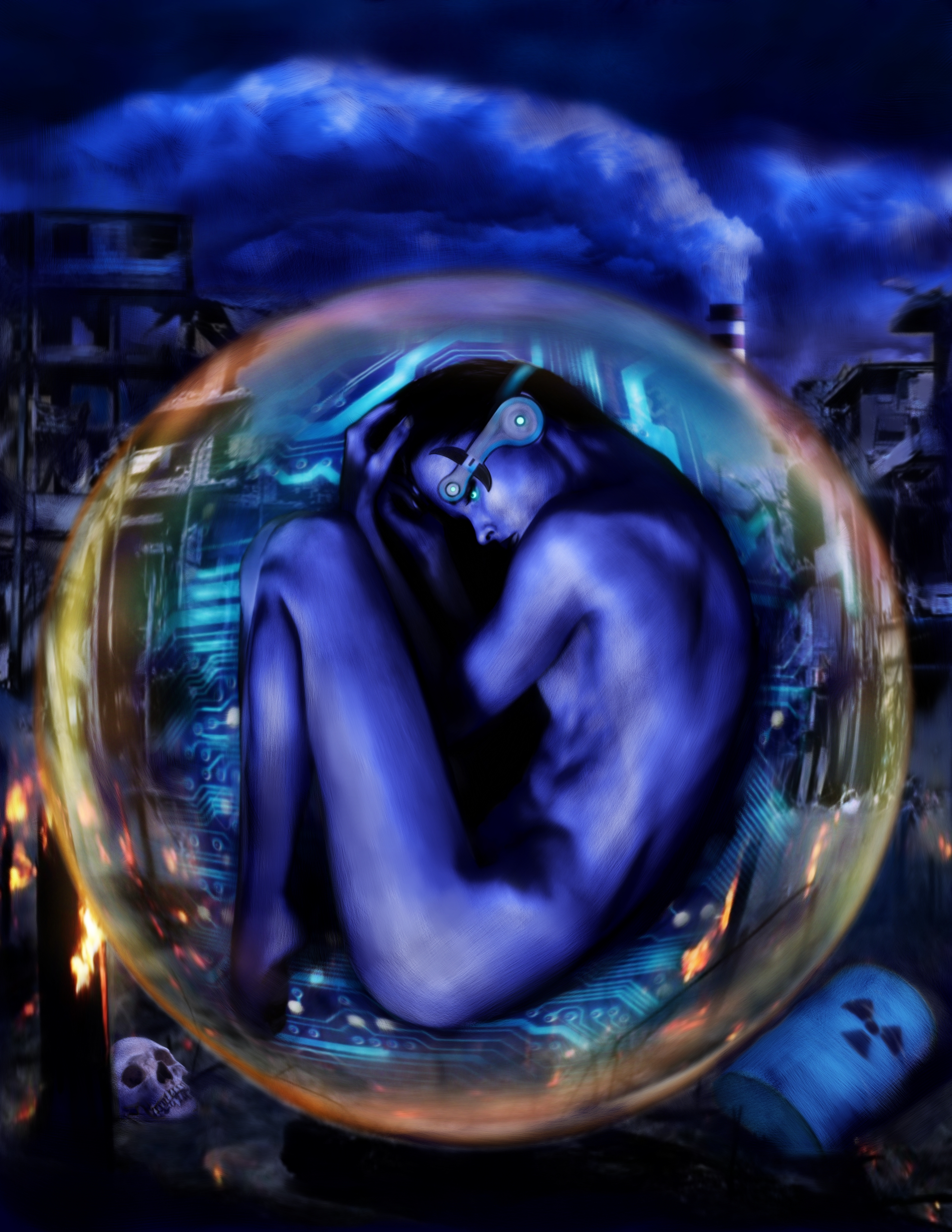
We will be featuring cover art "Denial" by Anselmo J. Alliegro. The artist says, "This painting depicts a retreat into a bubble, whether it be virtual, the media, or any medium that alienates us from each other and the natural world. The person floats inside a bubble of denial, while the environment outside is degraded and burning."
Stay tuned later in the month for a sneak peek of "Denial" right here!
When it comes to the final rankings of each editor, our subjectivity comes into play. I'm not sure if this is a good thing or a bad thing. One editor likes arty stories with a lot of pretty prose and descriptions and a vague or unresolved ending. One editor loves anything to do with dragons. One editor seems to like anything to do with quantum stuff. One editor likes stories with time travel. One editor likes stories with music. (Yes, that's a lot of editors.)
Some people call these preferences reader cookies--because they are a yummy treat for the reader. :)
I guess the bottom line for writers is: if you want to be published in a particular market, you should read the market to see what the editors like. Another take-away is: if your story isn't chosen, it could just be because of the subjectivity of the editors. A different editor or set of editors might love your story.
Next week I'll report on the production meeting.
In the meantime, in the age of Covid, I've been rereading a bunch of my nonfiction writing books. (How about you?) Writing advice really differs. At least one nonfiction author recommends keeping a writing journal and writing in it free hand everyday to keep the creative juices flowing. Another says keep a notebook/note app with you twenty-four seven to jot down ideas (like Agatha Christie!). One says write down ideas on a big sheet and connect them in a kind of idea cloud.
One says reject your first ideas because they're too obvious.
There's also the old adage: Write what you know.
I've been ruminating on all this advice. I think you should write what you're passionate about. When you write what you care out, the story comes alive for the author. This makes it come alive for the reader.
Bottom line: do whatever works for you.
Good luck whatever you decide to write about!
Within the last week, I read more stories that started with the protagonist waking up. Ugh. Try to avoid this. I read more stories that merely involved a man killing his romantic partner. Ugh. Try to avoid this.
Interestingly, I also read a couple stories with no showing. Ugh. Try to avoid this. If you read Electric Spec, you know we like some showing. Showing means dialogue, people talking to each other. Showing means characters acting in the moment. In contrast, telling means one person, such a narrator, telling the reader what happened. Some markets like telling; consider submitting your telling story there.
In these challenging times, consider distracting yourself by reading some free fiction at Electric Spec.
Stay safe and take care!
The submission deadline for the fabulous February 28, 2021 issue is Jan 15, 2021. Get those stories in! Of course, we'll be accepting subs for the next issue after that.
As you may or may not have noticed, some editors have already been going through slush. Some have not yet--but they will soon.
I have read a lot of stories already for this upcoming issue.
I have some tips (although I'm not sure that any of these are new):
Good luck!

Take care!
My favorite stories are usually those that hinge on very simple concepts. (My go-to example for this is usually 'It Follows,' a film whose entire hour and 47 minutes can neatly be described in just three words: sexually transmitted curse.) Even better if the story in question can pose a (hopefully) interesting question with which readers are left to grapple. In this case, I saw a chance to do both by literalizing a simple metaphorical concept with which most of us are probably familiar. We often say that loving someone is like giving them a piece of your heart. What if that was actually, painfully true? What if the ones who love us could take a piece of us with them?
Aside from the day-to-day problems this might present, it leaves readers with (what I hope is) a compelling question: what would you do if you knew that the more fiercely and frequently you loved, the less time you had left? I think a lot of us will tell ourselves that we would love just as freely and passionately as ever if faced with such a dilemma, but, really, who knows? Maybe not? Maybe we'd all hole up alone in the hopes of making it for the next hundred years.
Then again, what's the good of living for so long if you couldn't spend any of that time falling in love? (Other than avoiding contracting one of those pesky sexually transmitted curses that are always going around.)
Very interesting! Thanks, John!
Check out all our favorites in the new issue!
Hi everyone!
I've got a story in the Editor's Corner this issue, "The Dragon and the Shepherd." I thought I'd share a little bit about how this story came about.
First and foremost, this is a tribute to Luna:

My wife and I had the good fortune to be Luna's companions for about 12 years, before she moved on to her next adventure last year. We still miss her terribly.
I took almost no liberties with Luna's behavior and personality in the story... what you see is pretty much how she was (especially in her youthful, wildly athletic phase of life). If I wanted a companion on hand to help me break the ice with a dragon, I'd choose Luna anytime.
As for the rest of the story, it falls into some of the themes I like to explore in fiction. My dragons tend to be a mixture between the classic Western type (in physical appearance) and the Eastern dragons (as embodiments of natural forces). Mostly, I like my dragons to be fundamentally inscrutable. You can never really know all there is to know about them... and just when you think you've got them figured out, they show you something you'd never imagined.
The humans in the story are mostly so wrapped up in their own stuff that they can barely notice what's really going on around them, though our narrator is favored with one of those rare glimpses we are all afforded once in a while.
Another theme I find interesting is the danger of self-righteousness... perhaps because it's a tendency to which I am susceptible. David, the dragon's handler, exemplifies this trait. Even though his cause is sympathetic, his prickly attitude makes it hard to be on his side. Being right doesn't really give us a blank check to be righteous... though it's tempting to think it does.
Hope you enjoy the story!
-Grayson Towler, Editor
Thanks so much to all the authors!
Thanks so much to all the Electric Spec staff.
And, especially, thanks so much to all the readers!
Woo hoo!
Myths, social issues, and my own dreams and memories provide lots of writing fuel for me. I love writing speculative fiction because it’s an opportunity for me to view the world through a fractured lens and maybe, strangely, see things more clearly.
For this story, I was inspired by real life situations like Tinder. At the time I wrote this, I was teaching high school and my students were often on online websites on their phone instead of participating in class activities. When I wrote this story, I had caught one of my students on Tinder. Probably students shouldn’t have even been on Tinder because the age minimum is 18 years old, but that’s a separate issue. That incident was one of the starting points for this story.
Other inspiration for this story was that I used to live in Japan. I taught English there for two years. There are a lot of single young people. I had several Japanese acquaintances who were single women and unmarried. It was hard for them to date, more so than women here because of cultural values that made them feel like it was taboo to ask men out. In 2007, Internet dating was another taboo. Several Japanese women I met liked dating American men because foreigners do things that are considered chivalrous, like opening doors for women and giving them gifts. I was told by one Japanese woman, that isn’t part of their culture, so it is novel and exciting.
But there are also cultural differences that make interracial dating daunting. Americans are very cavalier and unguarded in conversation topics, so I wanted to include that kind of faux pas in the story.
Also while living in Japan, I learned about Japanese mythology and monsters, like the jorogumo, a spider woman. I have written several stories about jorogumo because I find spiders to be creepy. In my series, Womby’s School for Wayward Witches, one of the characters is secretly a jorogumo and hiding her true heritage. Probably I will write more jorogumo stories in the future as well.
The last piece of inspiration was that I had been writing about a male character who was obsessed with monster women and a female character obsessed with monster men. In the stories with Darwin, the male point of view character, he wants to date a monster, but they always beat him up in the end—sometimes intentionally, sometimes accidentally. They are all stand-alone stories but also build as a series. I wrote this story through the female monster’s point of view.
Someday I hope to sell all the stories in the series and then put them together in one collection.
According to the myth, a maiden rides the unicorn only once. What happens if she regrets taking the ride? In my story, 'The Healing of the Unicorn', she has the opportunity to heal her own and the unicorn's injury, and experience a re-awakening.
Enjoy the ride.
We mostly agreed on stories this time around, with a couple of exceptions. Suffice it to say, we came to an agreement pretty quickly. Not surprisingly, none of us were excited about publishing grim, depressing stories. So, writers: take note, moving forward.
All unsuccessful writers have been emailed with the bad news. :( Successful authors will hear back from us soon, if they haven't already. Return those contracts quickly, so we can start editing stories. Consider writing a post for this very blog. The online issue construction has begun.
For some reason, for each issue, it seems a story or two goes awry between the author and the editors. I don't know why this is. But, if you submitted before Oct 16 and didn't hear from us, please resubmit. If you got a rejection, don't lose heart; please resubmit.
Hopefully, by the time the November 2020 issue comes out, things will be going better with the world. Good luck to all of us!
Wow! There were a of tough decisions made! We received many good, publishable stories but had to winnow the list down to the top twenty for the production meeting.
Next time I'll tell you about the production meeting.
Take care!
Now that you've done your part, the editors are hard at work behind the scenes. We have to carefully read the hundreds of stories we received. We have about a week left to make the first pass throught the slush pile. Sadly, some of the stories will be rejected. All the Electric Spec editors are also writers, so we hate to do this, but it's part of the process. We'd love to write critiques of all the stories we receive, but we just don't have the resources for this. :(
I'll share more behind the scenes info here next week. For now, I better get back to work!
You may have heard the writing rule: 'Show, don't tell.' Like all writing rules, take this with a grain of salt. In general, however, fiction should include both showing and telling. The relative amount of showing and telling depends on the market. You can see the relative amounts of showing and telling by reading Electric Spec's (free!) past stories. We need some showing. In fact, I rejected a story recently that was all telling. Another market might have chosen it; but we would not.
Good luck with your showing and/or telling!
We've been reading the submitted stories. (Thanks for submitting!) I read one recently that started with ...a dream. In general, starting with a dream is problematic. This is because the beginning of the story is a promise of what's to come. If the story starts with skiing polar bears in a dream, there had better be something related to skiing polar bears at some point in the story. In addition, dreams are inherently irrational. Beginning with a dream promises irrationality in the story.
Thus, consider avoiding dreams in your story. Good luck whatever you decide. :)
I had an interesting discussion with one of the other Electric Spec editors lately. We both had an opportunity to read a new short story. I was charmed by the characters and steampunk world. The other editor did not enjoy the story. He essentially said, 'There's a loose thread, an unresolved story point.' I realized he was right. The protagonist released something into the world that had the potential to destroy said world, and didn't get it back. I'd been so distracted by other story elements I hadn't even noticed! Usually, I'm a better reader than that.
So, my advice to authors: avoid loose threads. Don't inadvertently, accidentally, destroy your world. Of course, if it's intentional, that's another matter entirely. :)
Good luck with your writing!
The approaching deadline means we're working hard on the submissions in the slush pile. I read a couple stories that did a good job of starting in media res--in the midst of things. This means the plot has already started and the story is off to a very fast start. In general, this is a good thing, unless...
Unless the reader doesn't get a chance to get to know the protagonist at all before he/she/it is robbed/shot/thrown off a cliff/cursed/etc. If the reader doesn't get to know the protag, it's hard for the reader to care if he/she/it is robbed/shot/etc.
Consider starting your story with a little ordinary life. Show the reader the protag before the dire events start, and if he/she/it saves a puppy or a baby, so much the better. :)
And, yes, I fully realize it's tricky to show ordinary life and still craft an interesting opening. But, that's why we writers get the big bucks (ha ha), fame, and satisfaction for art well-done.
Good luck!
Usually at this time of year I go to the Rocky Mountain Fiction Writers annual convention. Electric Spec editors have taught various workshops here in years past. This year Rocky Mountain Fiction Writers has joined forces with Northern Colorado Writers and Pikes Peak Writers to create a month long virtual conference free for everyone to attend!
This joint venture hits YouTube September 1-30, 2020. Check out free video presentations from agents, editors, and authors on the craft, business, and life of writing as well as current hot topics all writers should pay attention to. You’ll learn from NYT bestselling authors and awesome editors. Over twenty-five contributors have volunteered their time and effort to provide the writing world with some education, inspiration, and motivation during this time of safer-at-home.
If you're a writer or want to know more about writing, check it out here!
Thanks so much to all the authors!
Thanks so much to all the Electric Spec staff.
And, especially, thanks so much to all the readers!
Woo hoo!
"Nobody Gets Out Alive" was inspired by YouTube and gaming vloggers. Horror writers are not generally known for our mastery of technology, but that isn't really true. We must explain why our characters' cell phones don't work when they're being stalked by the killer, and why there are still no good pictures of Bigfoot when everyone now has a camera and there are trail cams all over the place.
Sometimes when I write, I like to think about the secondary effects of technology (thanks to author Laura J. Mixon, who explained the concept). I went to many rock concerts as a youth, and watched teenagers wave their cigarette lighters during the power ballads. Twenty years later, those selfsame thirty-somethings were waving their cell phones during the same power ballads (reunion tours rule!). Not what cell phones were designed to do, but they get the job done. Nowadays, people can watch rock concerts on their smartphones, if they have the battery power.
"Nobody Gets Out Alive" was inspired by a secondary effect of technology, the fact that a person can now make a living playing video games on YouTube. Vlogging is a precarious existence – posting every day, so your audience won't forget you; pretending to like a game you've played every day for two months straight; obtaining a weird sort of pseudo-celebrity, wherein total strangers act like you're their best friend or even fall in love with you. Then there's the worst-case scenario – that bestselling game you're vlogging about turns ice cold, and you're washed up at the age of twenty-three.
Thanks, George! Very interesting! Be sure to check out Nobody Gets Out Alive and the other stories on August 31st, 2020!
I couldn't tell you where, exactly, the idea for Hot Crow and Paper Lion came from. I recall the crow appearing before my mind's eye, majestic and fully formed, tipping his top hat to me. But I can't tell you why or where he came from. What I can tell you is this: I wasn't thinking about writing.
There seems to be two approaches you can take to creative ideas. The first involves sitting down with a notepad, taking a pen or pencil, or even booting up the computer and prepping a blank page on your favourite word processor. Then you say to yourself, Okay, I really need a new idea. I want to write a new short story. So you stare at the page, you tap your pen (probably not your laptop, though) against your forehead as if the action will dislodge something brilliant. You stare into space and think -- think really hard -- about characters, stereotypes, how you might break from a stereotype, fantastical creatures, a world newly forged from stardust, maybe some type of magic no other writer has conjured. Sometimes it works. Sometimes, your minutes or hours with the blank page and the writing tools you've gathered over the years produce something worthwhile.
Then there's the other method. And it isn't much of a method at all. It's called Getting on with Life. Just going about your daily activities -- work, hobbies, family time. Anything but writing. And definitely not thinking really hard. Walking around, admiring the views, absorbing the world and life.
And then -- ah! What's this? An idea. Random? Maybe. Or some amalgamation of things subconsciously blended into something new and interesting. It's as if a veil has been lifted and you've glimpsed something that was there all along, hidden.
I know which approach I enjoy the most. Some of my best ideas come from not trying to think of ideas. Not actually writing at all. And that's where Hot Crow came from, beyond the Veil, with Paper Lion prowling close by.
Thanks, M J! Very interesting! Be sure to check out all the stories on August 31, 2020!
"Smithsonian Soldiers" is another story of mine inspired by a dream. My subconscious seems to delight in coming up with weird, visually intriguing ideas. If the idea sticks with me long enough after I wake up, I usually write it down in one of my journals with a fountain pen and keep writing until my hand gives out or I finish a draft. I took up fountain pens before being diagnosed with multiple sclerosis but given the symptoms I've had fountain pens have let me keep writing when computers aren't a great option.
Rewriting is actually my favorite part of the storytelling process. I savor tinkering with words and punctuation to craft the story that I want to tell. Most of my stories go through a minimum of four revisions. There is nothing like that satisfying feeling of saving the final version of a story and knowing it is complete.
Very interesting! Thanks, E.A.!
Thus, authors should hear back from us this week with a 'yea' or 'nay.' If you submitted a story between April 16, 2020 and July 15, 2020 and you don't hear from us, something likely went awry. Sorry! Resubmit.
If you are a lucky author, please do return your contract quickly. This enables us to start editing quickly. In addition, please do send us a blog entry, which I will post here. It's super fun to hear from authors! Don't you think?
We also have some really nice art and maybe something in Editor's Corner, so be sure to check out the new issue on August 30, 2020! Woo hoo!
Scientists think people can train themselves to be more creative.
Next week I'll talk about the production meeting. Take care!
Slush We have about another week to finish up the first reads of slush. All the editors work on this. If you want to know a little bit more about us, you can read about us here.
Each story submitted is rejected (sorry!) or held for voting (yay!). Each of the senior editors ranks the stories in hold-for-voting, #1 for the best, and #whatever for the worst (ouch!). We compute numerical totals for each story.
Production Meeting We have our production meeting at the beginning of August. In 2020 we've been meeting virtually. :( We debate the various stories and decide on the ones in the issue. Usually, the stories with the lowest numerical totals get in the issue. We do try to pick a mix of speculative fiction genres. We also choose the cover art and assign various other tasks such as the Letter From the Editor. Soon after the meeting, we email out the good or bad news to each of the authors.
Issue Creation We do the tasks to put the issue together. After we get contracts back for the lucky authors we start editing the stories. The amount of editing necessary varies greatly by story. Once the content is in good shape, the stories are proofread. Then, we make the preview versions of the story webpages and ask authors for final okays. We create other elements of the issue, as needed.
Publication We publish the issue! Ta-da! And pay the authors and artist. :)
I better get back to work...
Your story opening is crucial. I can't emphasize this enough. With hundreds of stories to read, if your opening isn't very good, editors may stop reading.
As an author myself, I know this is hard to internalize. I have written stories that I thought were really good and seen editors say, "The first paragraph was boring." And I thought, "But the next paragraph is awesome!" Too late. The editor has already rejected it.
A common issue I see is starting the story on the page before the story really begins. As an example, about a third of the stories I read the other day began with the protagonist waking up. Seriously. This is not a strong opening. I didn't hold any of these stories for voting. Another common issue is significant spelling, word choice, and/or grammar problems. These kinds of stories are more work for our editors, so more likely to get rejected.
Thus, please review your first page one more time before you send in your story. We want your story to shine. Good luck!
As I read slush, I'm reminded of a tip from a famous editor: utilize try-fail cycles. A try-fail cycle is exactly what it sounds like. Your protagonist tries something (usually to solve a problem), and is not successful, and then tries something else... Most authors write these organically, without ever thinking Now, I need a try-fail cycle. It can be helpful, however, to consciously think about them.
Consider a definition of a story: a protagonist has a problem and acts to solve it. If the protag acts and is successful, a try-succeed instance, this is not an interesting story. Is it even a story? If the protag merely acts and fails, a try-fail instance, again, this isn't an interesting story. Thus, the cycle aspect of the try-fail cycle is also important. The protag needs to try more than once.
Most interesting stories have a series of try-fail cycles with increasing stakes. This makes the story more dramatic and gives the reader a more satisfying emotional payoff in the end. Try-fail cycles show and enable character growth. They also allow the overall story plotline to twist, change, grow. They make a short story much deeper and more interesting.
So, if your story is dragging, consider adding another try-fail cycle. Good luck!

 Posts
All Comments